Attosecond Hard X-Ray Pulses Reach Above 10²⁰ W/cm² in a 180 × 330 Nanometre Focus as European XFEL and DESY Shift the Bottleneck From Generation to Delivery
European XFEL, DESY and the Universities of Hamburg and Tokyo used a four-reflection Kirkpatrick–Baez mirror system to focus 300-attosecond hard X-ray pulses to a nanometre-scale spot, moving the constraint from generating pulses to delivering them.
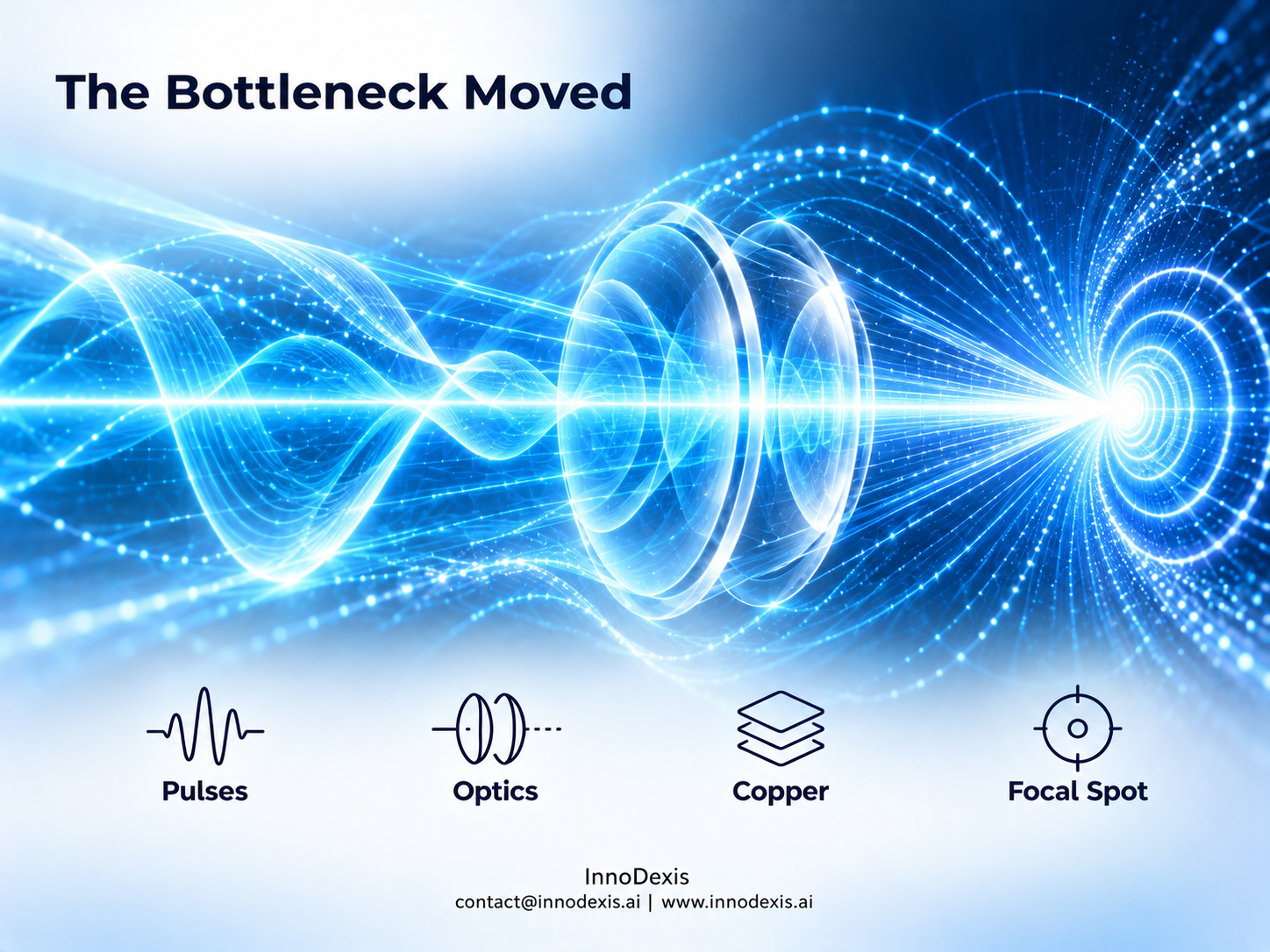
InnoDexis has published its latest Innovation Intelligence Report covering attosecond X-ray science and ultrafast photonics, analyzing a single innovation developed jointly by four institutions: European XFEL, DESY, and the Universities of Hamburg and Tokyo. The report reveals that focusing attosecond hard X-ray pulses with a four-reflection Kirkpatrick–Baez mirror system delivers short pulses and a nanometre-scale focal spot together, reaching a peak intensity above 10²⁰ W/cm². The report identifies delivery to the sample, rather than pulse generation, as the bottleneck this work addresses, with routine researcher access targeted for 2027.
Key Findings
Peak intensity exceeded 10²⁰ W/cm² at the focus. At this intensity, nonlinear X-ray–matter interactions become accessible, which is the regime this result opens for researchers working with attosecond hard X-ray pulses.
The pulse duration was 300 attoseconds. Pulses faster than electron motion capture atomic states before damage occurs, which is the property that makes this duration scientifically useful and distinguishes these pulses from slower probes. The pulses are described as a start toward tracking, and potentially manipulating, electronic motion.
The focal spot measured 180 × 330 nanometres, a focal area roughly 100,000 times smaller than a hair’s cross-section. Short pulses and a small focal spot now arrive together, rather than separately, and the focal spot is what the focusing optics were built to reduce. The comparison to a hair’s cross-section conveys the scale of that reduction.
A four-reflection Kirkpatrick–Baez mirror system performed the focusing. The result therefore indicates that focusing optics alone can unlock more from existing X-ray facilities, which positions optics as a source of capability gains at facilities that already operate.
Intensity was confirmed independently through a change in the direction of emitted light. Normal fluorescence radiates in every direction, but past the emission threshold the light cone condenses forward, and in copper foil that shift independently confirmed the intensity. The proof, in other words, was a change in light direction rather than a single number, and it supports the intensity figure reported above.
Strategic Insight and Trend Analysis
The dominant trend in this dataset is a relocation of the bottleneck in attosecond science. Generating attosecond pulses was never the constraint; delivering them to the sample at useful intensity was. By focusing pulses at the sample rather than only producing them at the source, this work moves the point of leverage from the pulse generator to the focusing optics.
This matters because short pulses and a small focal spot now arrive together. A 300-attosecond duration allows atomic states to be captured before damage, while a focal spot of 180 × 330 nanometres concentrates the pulse to an intensity above 10²⁰ W/cm². Neither property alone reaches the nonlinear X-ray–matter regime; the combination does, and that combination is the structural advance. Delivery, not generation, is now the variable that determines what these pulses can do.
The wider implication is that existing X-ray facilities may hold more capability than their current configurations deliver. Because the result comes from a four-reflection mirror system, the gain is attributed to optics rather than to a new source, which points toward a lower-barrier route to expanded capability across facilities that already operate.
The data also frames a longer path. This is described as a start toward tracking, and potentially manipulating, electronic motion. With routine access for researchers targeted for 2027, the open question shifts from whether such pulses can be focused to which applications benefit first, and which chemistry-driven industries will move first once electron motion in chemical reactions becomes directly observable.
Global and Industry Implications
For corporates and R&D teams, particularly in chemistry-driven industries, the result points toward a future in which electron motion in chemical reactions becomes directly observable. Teams that depend on molecular and materials characterisation now have a defined date to plan around, with routine researcher access targeted for 2027, and a clear indication that access depends on focusing capability.
For investors and capital allocators, the finding indicates that focusing optics can unlock more from existing X-ray facilities. Value in this field may therefore sit in delivery-side optics and instrumentation, not only in new pulse sources, and the 2027 access target, which applies to routine researcher use, gives a reference point for assessing how quickly this capability moves from demonstration to routine use.
For policymakers and national innovation bodies, the four-institution collaboration illustrates how shared research infrastructure can be extended through optical engineering. Investment in focusing capability at existing facilities is a pathway to expanded researcher access, and the 2027 target provides a timeline against which that access can be tracked, alongside the broader question of which chemistry-driven industries benefit first.
InnoDexis Statement
“The constraint in attosecond X-ray science has moved from generating pulses to delivering them, and focusing optics alone can now unlock more capability from existing X-ray facilities,” noted InnoDexis in its latest intelligence report.
Conclusion
The next phase to watch is access. With routine researcher use targeted for 2027, attention will turn to which applications use nonlinear X-ray–matter interactions first, and to whether electron motion in chemical reactions becomes directly observable in practice. Which chemistry-driven industries move first is the open question the data leaves. InnoDexis will continue to track attosecond science, ultrafast photonics, and X-ray focusing optics as this capability reaches researchers, and remains the platform to follow for continued intelligence on this domain. The complete Attosecond X-Ray Focusing Innovation Intelligence Report is available to InnoDexis subscribers and enterprise clients.
About InnoDexis
InnoDexis is a real-time innovation intelligence platform connecting scientific discovery to commercial opportunity. Powered by InnoGraph, its proprietary innovation knowledge graph, the platform maps technologies across the entire lifecycle, from early-stage research (TRL 1) to market deployment (TRL 9), connecting researchers, institutions, startups, companies, products and emerging opportunities.
Covering 40+ specialised industry segments and 360 technology areas, InnoDexis delivers innovation tracking, research discovery, product and startup intelligence, investment insights, and AI-powered reports. Its mission is to bridge the gap between scientific discovery and real-world impact.
InnoDexis — From Lab to Market: Real-Time Innovation Intelligence.