ATLAS and CMS Confirm First Quantum Entanglement Between Spin-1 Z Bosons in Higgs Decays at the LHC
CERN's ATLAS and CMS Collaborations found cross-validated evidence of quantum entanglement between Z boson pairs produced in Higgs boson decays, extending confirmed entanglement beyond fermions into force-carrying bosons for the first time.
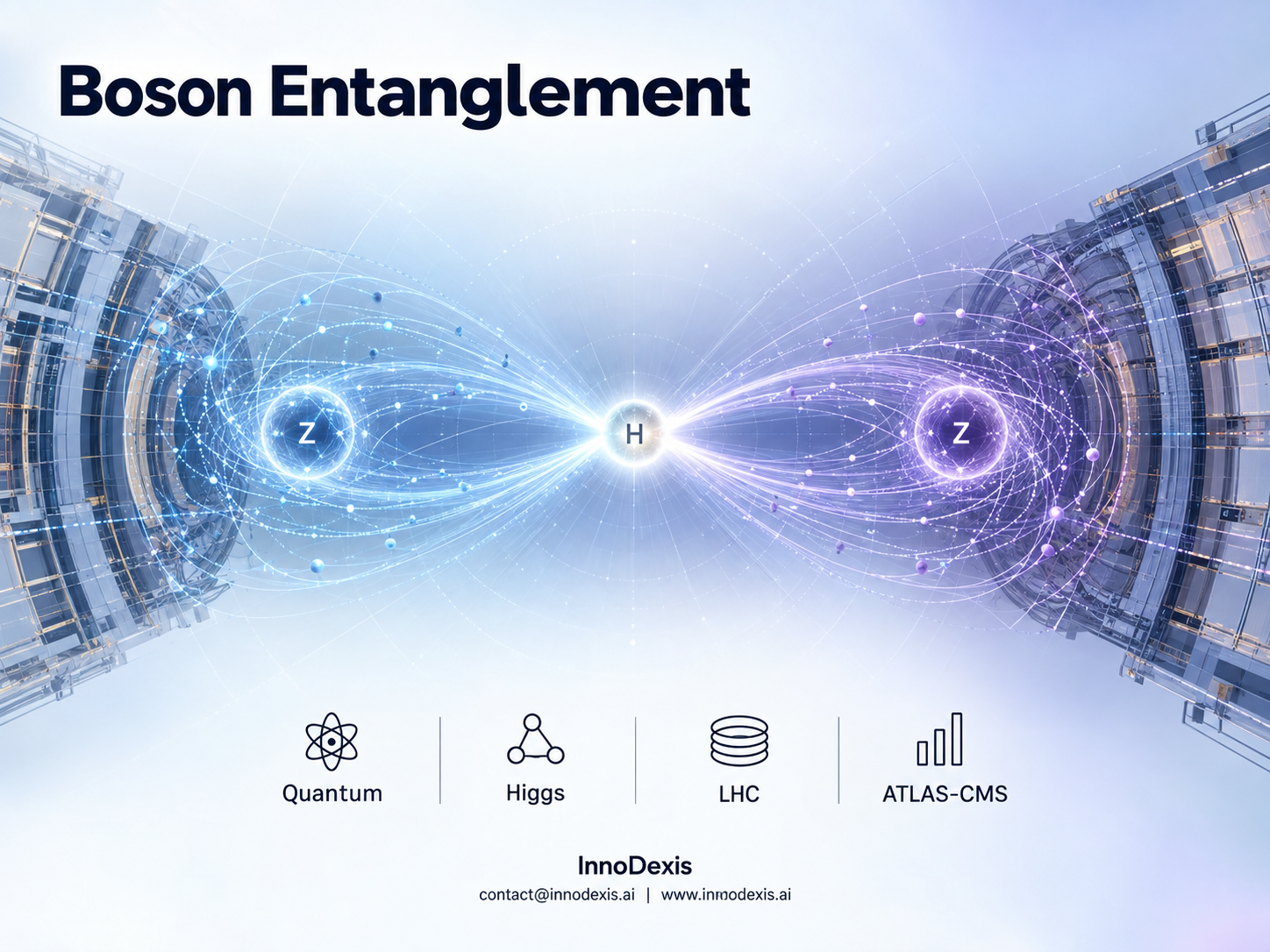
InnoDexis has published its latest Innovation Intelligence Report covering fundamental particle physics and quantum mechanics, analyzing a joint finding from the ATLAS and CMS Collaborations at CERN using LHC Runs 2 and 3 data. The report reveals that researchers found strong evidence of quantum entanglement between Z boson pairs produced in Higgs boson decays — the first such evidence in spin-1 particles, a physical regime distinct from the spin-1/2 top quarks in which entanglement had previously been observed.
Key Findings
The finding represents the first evidence of quantum entanglement between two Z bosons, which are spin-1 particles, unlike the spin-1/2 top quarks in which entanglement had previously been studied. This distinction places the result in a different physical regime than prior entanglement observations, extending confirmed quantum behaviour into a new particle class.
Z bosons carry three possible spin states — minus one, zero, and plus one — while the parent Higgs boson from which they are produced has a total spin of zero. This spin structure provided the specific physical configuration in which the entanglement signature was identified and reconstructed.
The result was cross-validated independently across both the ATLAS and CMS detectors at CERN. Independent confirmation across two separate detector systems strengthens the reliability of the finding, as it reduces the likelihood that the observed correlation is an artefact specific to a single detector's measurement approach.
The entanglement was reconstructed indirectly from short-lived decay products rather than observed directly, with the correlation appearing in decay angles for a fraction of a second before vanishing. This reflects the practical constraint of studying entanglement in particles that decay almost instantaneously, requiring inference from decay-angle correlations rather than direct observation of the entangled state itself.
The measurement was conducted using data from LHC Runs 2 and 3, confirming that quantum entanglement — previously tested extensively at low energies — also holds at the considerably higher collision energies achieved at the Large Hadron Collider.
Strategic Insight and Trend Analysis
The dominant significance of this finding is the extension of confirmed quantum entanglement from low-energy fermion systems into a fundamentally different physical regime: high-energy, spin-1 force-carrying bosons produced in Higgs boson decays. Quantum entanglement has been tested extensively at low energies in prior physics research, but this result confirms the phenomenon persists at LHC collision energies and in a particle type — spin-1 bosons — that had not previously been examined for entanglement.
This shift carries structural importance for how the Higgs boson is used as a research tool going forward. By demonstrating that entanglement can be reconstructed from Z boson pairs produced in Higgs decays, the finding establishes the Higgs boson as a working laboratory for testing relativistic quantum entanglement — a capability that did not previously exist in this form. This reframes the Higgs boson's research utility beyond its role in the electroweak symmetry-breaking mechanism, positioning it as an experimental platform for probing quantum correlations at collider energies.
The independent cross-validation across the ATLAS and CMS detectors is strategically significant in its own right. Because both detector collaborations arrived at consistent evidence using their own independent measurement systems, the finding carries a higher evidentiary standard than a single-detector result would, which is particularly important for a first-of-its-kind observation in a new particle class.
Looking forward, the upcoming High-Luminosity LHC will generate substantially larger datasets, which the report identifies as enabling more precise tests of this entanglement signature and potentially revealing further quantum phenomena at Higgs boson decay energies that current dataset sizes cannot resolve.
Global and Industry Implications
For corporates and R&D teams working in quantum technology and precision measurement instrumentation, this finding demonstrates that entanglement signatures can be reconstructed from short-lived, indirect decay products at collider energies — a methodological approach with potential relevance to quantum sensing and measurement techniques operating in high-energy or high-noise environments.
For investors and capital allocators, the establishment of the Higgs boson as a viable testbed for relativistic quantum entanglement research signals continued scientific momentum in fundamental physics infrastructure, particularly as the High-Luminosity LHC upgrade approaches, which the report indicates will generate substantially larger datasets for more precise follow-on tests.
For policymakers and national innovation bodies, this result reinforces the continued scientific return generated by sustained investment in large-scale international research infrastructure such as CERN, where independently cross-validated findings across multiple experimental collaborations produce evidentiary standards that smaller or single-institution facilities cannot replicate.
InnoDexis Statement
"Cross-validated evidence of entanglement between spin-1 Z bosons extends confirmed quantum behaviour into a physical regime never previously tested, establishing the Higgs boson as a new laboratory for relativistic quantum entanglement research," noted InnoDexis in its latest intelligence report.
Conclusion
As the High-Luminosity LHC prepares to generate substantially larger datasets, the entanglement signature confirmed between Z boson pairs in Higgs boson decays is likely to be tested with greater precision, potentially revealing further quantum phenomena in this energy regime. This result marks a meaningful extension of confirmed quantum entanglement beyond low-energy fermion systems into high-energy, force-carrying bosons, and establishes a new experimental pathway for probing quantum mechanics at collider energies. InnoDexis will continue to monitor developments in fundamental particle physics, quantum entanglement research, and CERN's experimental programme. The complete Quantum Entanglement in Particle Physics Innovation Intelligence Report is available to InnoDexis subscribers and enterprise clients.
About InnoDexis
InnoDexis is a global Innovation Intelligence platform that tracks, analyzes, and interprets breakthrough innovations, prototypes, and emerging technologies across industries and countries. Its intelligence helps corporates, investors, and policymakers understand the true structure and direction of global innovation. Learn more at innodexis.ai.