Astrophotonics Chip Only Centimetres Wide Replaces Multi-Metre Beam Combiners as Heriot-Watt’s CHARIOT Detects Fainter Stars at the CHARA Array
Heriot-Watt University’s laser-inscribed glass chip, operating inside the CHARIOT instrument, delivered the first on-sky observations with an integrated optics beam combiner at the CHARA Array and detected stars fainter than the system it replaced.
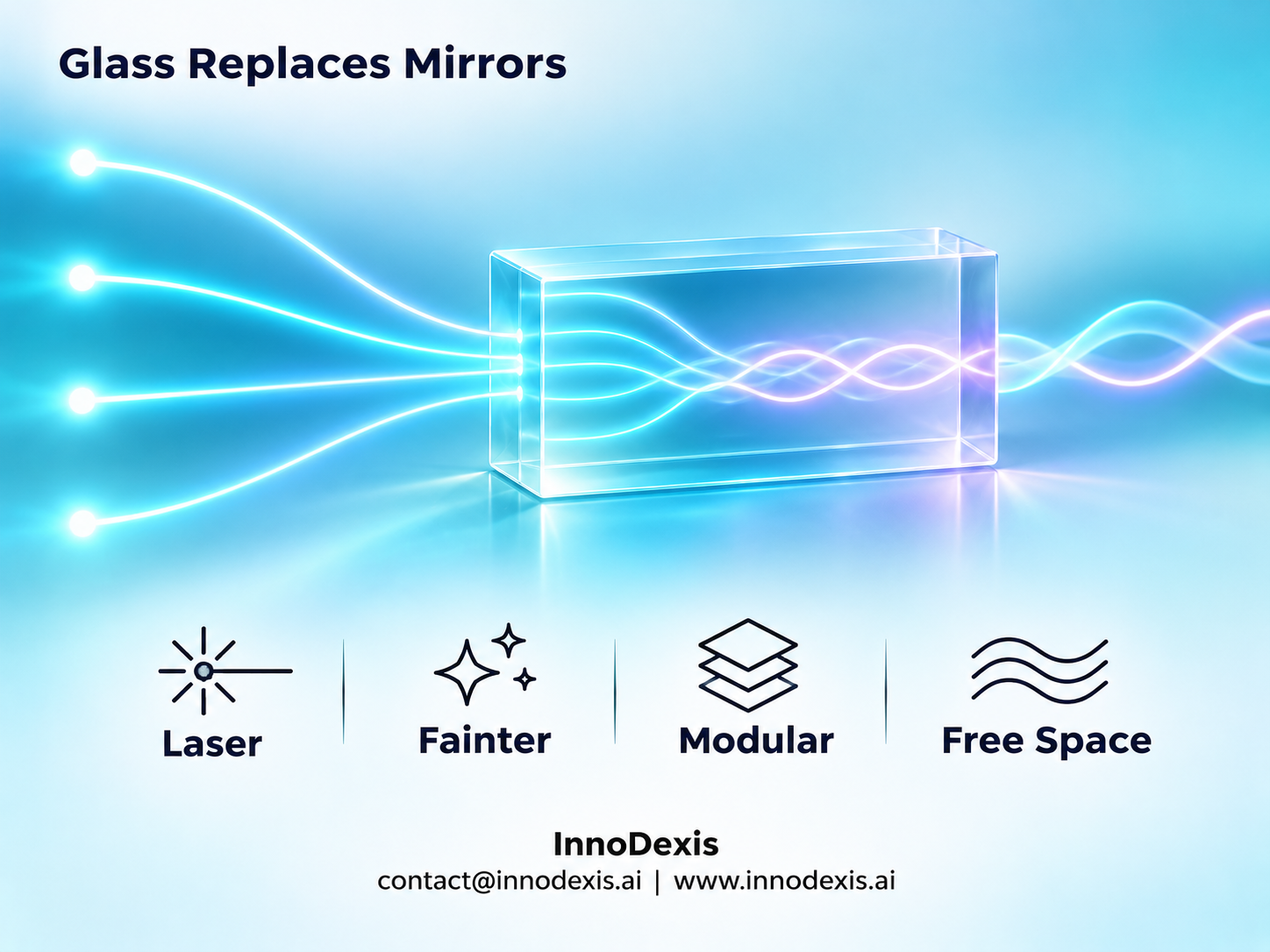
InnoDexis has published its latest Innovation Intelligence Report covering astrophotonics and high-resolution astronomy, analyzing one innovation from Heriot-Watt University in the United Kingdom, published on 27 October 2026. The report reveals that a glass photonic chip only a couple of centimetres in size, fabricated by ultrafast-laser inscription, replaced bulky mirror and lens beam combiners at the CHARA Array, delivered the first on-sky observations with an integrated optics beam combiner, and detected signals from stars fainter than those reached by the system it replaced.
Key Findings
The chip delivered the first on-sky observations using an integrated optics beam combiner at the CHARA Array. It operates inside an instrument called CHARIOT, with observing campaigns conducted in 2024 and 2025, and it is operational on a real-world telescope facility after a research programme that began more than 15 years ago.
The chip is only a couple of centimetres in size and replaces multi-metre mirror-based beam combination infrastructure. Combining the light from several telescopes, so that they act as one larger instrument, previously required bulky arrangements of mirrors and lenses. The glass chip offers a smaller footprint, higher stability and lower complexity, which reduces instrument size, cost and complexity.
The system detected signals from stars fainter than those reached by the system it replaced. This sensitivity gain is the most direct performance evidence in the record, although insertion loss within the glass channels is noted as a limit on sensitivity to extremely faint targets.
The chip is made by ultrafast-laser inscription inside innovative glass, which opens a previously unexplored spectral range, the K-band. This automated and repeatable writing process replaces labour-intensive free-space mirror and lens alignment, and laser-written glass chips can be mass-produced.
CHARIOT uses a modular design in which the photonic chip can be replaced within hours. This allows increasingly advanced chips to be tested and validated quickly on a telescope array. Commercial readiness is rated medium, because the technology is operational but specialized for scientific instrumentation.
Strategic Insight and Trend Analysis
The dominant trend in this research is the move of complex optical functions from free-space components into a single solid glass chip that works under real observing conditions. Robert Thomson, who leads the work at Heriot-Watt, describes the progression from fundamental research and early laboratory demonstrations to successful operation at one of the world’s leading facilities. The shift matters because it turns beam combination from a fixed, bulky installation into a compact component that can be swapped and upgraded.
The strategic value lies in that upgradability. Because the chip can be replaced within hours, each new design can be tested on sky quickly, which creates a platform for rapid iteration rather than a one-off instrument. The next steps identified are higher channel counts for simultaneous six-telescope beam combination and operation in spectral bands beyond the K-band.
The record is clear about what remains open. Technical risk is low for the current operational scope, but scaling channel capacity is the primary risk. Optical channels can degrade or misalign with environmental temperature shifts, maintaining extreme optical phase alignment across distant sources is a challenge, and minimizing photon insertion loss in the glass microchannels is still required.
The timeline is staged. Broader integration across ground-based interferometers is expected within 1 to 3 years, and potential space-based missions within 5 to 10 years. Competing integrated photonic platforms, such as silicon photonics, are the main threat to adoption.
Global and Industry Implications
For corporates and R&D teams, the work offers aerospace and defense, optics and photonics, and scientific instrument companies a route to miniaturized, high-precision optical payloads. Emerging applications named include satellite-to-satellite laser communications, compact optical sensing systems and quantum optical interconnects, though the approach requires high-precision laser fabrication facilities.
For investors and capital allocators, the market is narrow at present, limited mainly to specialized astronomical observatories and research institutes. Opportunities lie in integration into future space telescopes, where mass and volume constraints are critical, and in expansion into general optical sensing and photonic communications. Readiness is medium, and space-based use sits 5 to 10 years away. Competing integrated photonic platforms, such as silicon photonics, are the main threat.
For policymakers and national innovation bodies, the programme shows a path from more than 15 years of fundamental research to operational testing at the CHARA Array through international collaboration across the United Kingdom, Germany and the United States. No regulatory approval is apparent, so the main requirements are sustained research funding and access to precision fabrication capability.
InnoDexis Statement
“Moving beam combination from metre-scale free-space optics into a swappable laser-written glass chip turns an observatory instrument into an upgradable platform, and scaling to all six telescopes is the next structural test,” noted InnoDexis in its latest intelligence report.
Conclusion
The next milestones to watch are chip designs with higher channel counts for simultaneous six-telescope beam combination, and operational testing in spectral bands beyond the K-band. Broader integration across ground-based interferometers is expected within 1 to 3 years, with potential space-based missions in 5 to 10 years. Insertion loss and temperature stability at higher channel counts are the technical tests. InnoDexis will continue to track astrophotonics, integrated photonics and ultrafast laser material processing as this field develops. The complete Astrophotonics and Integrated Optics Innovation Intelligence Report is available to InnoDexis subscribers and enterprise clients.
About InnoDexis
InnoDexis is a real-time innovation intelligence platform connecting scientific discovery to commercial opportunity. Powered by InnoGraph, its proprietary innovation knowledge graph, the platform maps technologies across the entire lifecycle, from early-stage research (TRL 1) to market deployment (TRL 9), connecting researchers, institutions, startups, companies, products and emerging opportunities.
Covering 40+ specialised industry segments and 360 technology areas, InnoDexis delivers innovation tracking, research discovery, product and startup intelligence, investment insights, and AI-powered reports. Its mission is to bridge the gap between scientific discovery and real-world impact.
InnoDexis — From Lab to Market: Real-Time Innovation Intelligence.