Artificial Intelligence Penetrates 77.5% of May 2026 Corporate Records as Agentic AI Emerges as the Fastest-Growing Sub-Technology and Healthcare Leads All Sectors at 517 Innovations
A cross-sector analysis of 2,702 AI-relevant corporate records across 11 industries finds that artificial intelligence has completed its transition from vertical technology to horizontal economic infrastructure, with agentic AI, robotics and automation, and quantum-AI convergence defining the three most strategically significant forward signals.
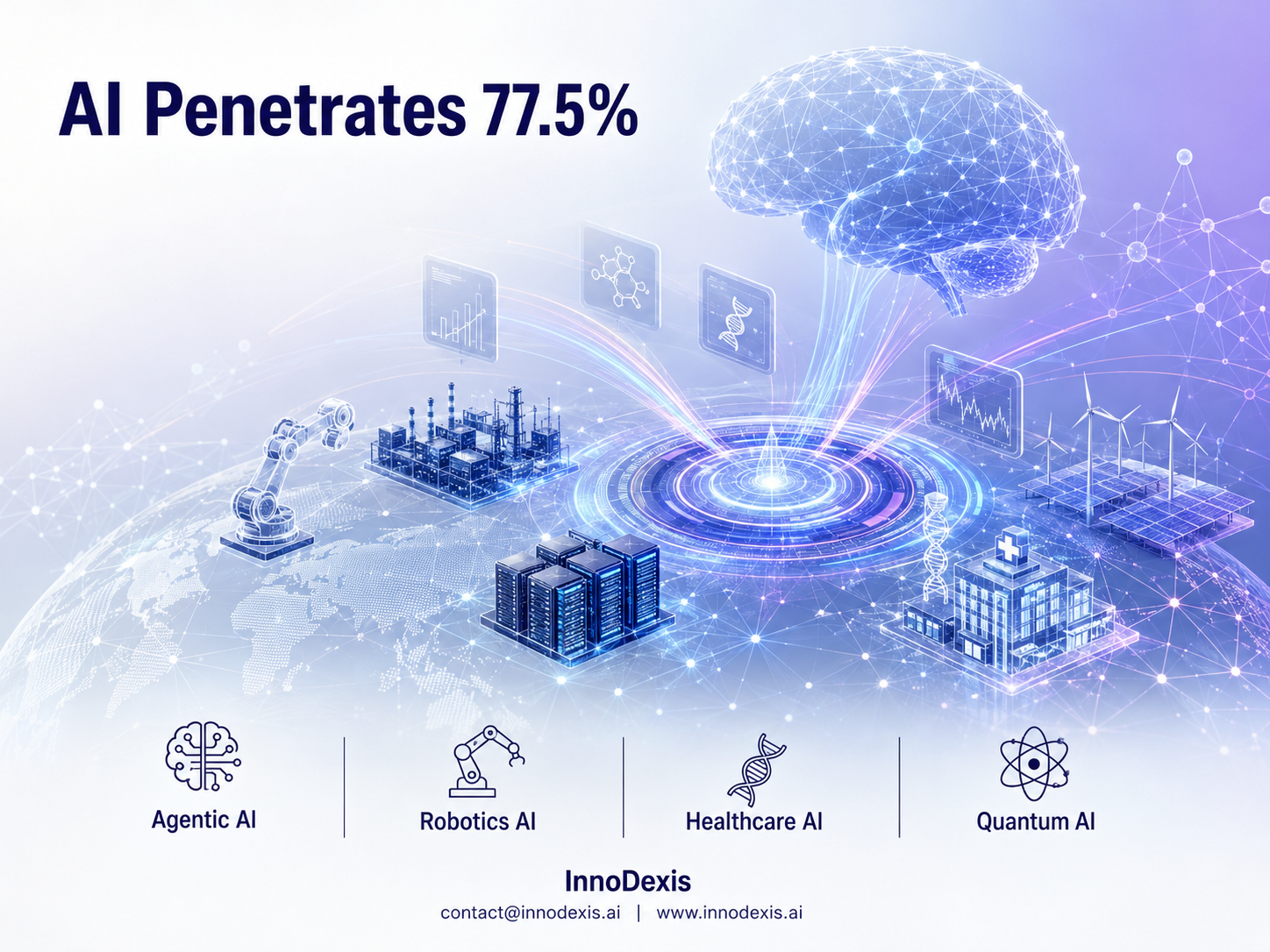
InnoDexis has published its latest AI Innovation Intelligence Brief covering global corporate AI activity, analyzing 2,702 AI-relevant records extracted from the May 2026 corporate dataset of 3,486 validated announcements — representing 77.5% of all records captured that month. The report reveals that artificial intelligence is present across all 11 tracked sectors, that 34.5% of AI records carry a High market momentum signal above the full-dataset average of 32.5%, and that agentic AI with 156 records is the fastest-growing sub-technology category with a mean InnoDexis score of 6.4 — above the overall AI mean of 5.7.
Key Findings
Healthcare is the single largest AI-impacted sector with 517 records — 19.1% of all AI activity — spanning diagnostics, clinical trial platforms, AI-powered genomics, digital health navigation, and surgical AI across all technology readiness stages from clinical-stage drug discovery at TRL 4 to 5 through fully deployed telehealth and diagnostic platforms at TRL 9. Garner Health raised a USD 100 million Series D to expand its AI-driven care navigation model nationally, using clinical outcome data to match patients with high-performing physicians. Caris Life Sciences launched its Caris Molecular Intelligence platform providing AI-powered genomic testing that identifies treatment paths for cancer patients at the molecular level — both records scoring 9 on the InnoDexis Corporate Scale.
Robotics and Automation leads all nine AI sub-technology categories with 287 records spanning manufacturing, logistics, healthcare, autonomous drone systems, and AI-guided industrial inspection across multiple primary industries. Generative AI and large language models follow at 170 records, concentrated in enterprise software, media, and defence. Agentic AI at 156 records registers the highest average InnoDexis score density among all sub-technology categories at 6.4, with production-grade agentic architectures documented in enterprise customer experience, clinical decision support, AI trading, and autonomous systems — confirming its position as the primary product development vector for Q2 2026.
The largest single AI funding event in the dataset is Parloa's USD 350 million Series D at a USD 3 billion valuation, positioning its agentic AI management platform for enterprise customer experience at global scale through integrations with SAP and Microsoft. Gray Swan, a Carnegie Mellon University spinout focused on adversarial AI testing and safety assurance, raised a USD 40 million Series A — the month's most strategically significant early-stage signal, addressing the growing enterprise and government requirement for AI red-teaming and accountability infrastructure ahead of anticipated regulatory frameworks.
AI infrastructure records total 107, spanning AI chip production, data centre construction, and power management — the enabling constraint layer for the entire AI stack. AMD commenced production of its sixth-generation EPYC CPU using TSMC's 2-nanometre process, a critical milestone for next-generation data centre AI workloads. GlobalFoundries expanded fabrication capacity to support quantum technology and AI semiconductor production under government backing, directly addressing the US domestic AI supply chain strategy. Google's USD 15 billion data centre commitment, captured within the infrastructure cluster, illustrates the co-dependency between AI infrastructure demand and energy transition investment at capital allocation scale.
Quantum and AI convergence generates 44 records — a 40% increase from the prior-month baseline — with applications spanning quantum chemistry for drug discovery, quantum key distribution for cybersecurity AI, and quantum machine learning for financial optimisation. Pasqal, a European neutral-atom quantum computing company, is pursuing a SPAC merger with USD 500 million in expected proceeds, validated by enterprise deployments including Aramco's national quantum computing installation and NVIDIA high-performance computing integration. Atom Computing secured a US government contract for quantum computing capabilities, confirming that quantum-AI convergence is entering government procurement pipelines alongside commercial deployment.
Among the 1,754 ESG-tagged records in the full May 2026 dataset, 891 — or 50.8% — also carry AI signals, confirming that artificial intelligence is now structurally embedded in corporate ESG strategy rather than operating as a separate technology initiative. Key patterns include AI for carbon accounting, AI-driven supply chain sustainability analytics, AI for biodiversity monitoring, and AI governance frameworks aligned with EU AI Act compliance requirements. The 304 AI records at TRL 4 to 5 within the dataset represent innovations between 12 and 24 months from commercial deployment — a pre-commercial pipeline structurally absent from financial data platforms that index only commercially active announcements.
Strategic Insight and Trend Analysis
The central analytical finding of the May 2026 AI Intelligence Brief is that artificial intelligence penetration at 77.5% of all corporate records is not a measurement of how many companies are talking about AI — it is a measurement of how deeply AI has been embedded into the operational and product architecture of the commercial economy across every sector simultaneously.
The sector distribution confirms this reading. Healthcare, financial services, retail and consumer, enterprise software, automotive, defence, media, education, energy, and biotech all carry significant AI record concentrations, and the cross-sector Other category at 713 records confirms that a further quarter of AI activity cannot be classified within a single primary industry. This is the structural signature of a horizontal capability rather than a vertical technology.
Agentic AI is the most consequential forward signal in the dataset. At 156 records and a mean InnoDexis score of 6.4, it is simultaneously the fastest-growing sub-technology category and the highest-scoring. The convergence of large language models, tool-use frameworks, and orchestration architectures — evidenced by Parloa's enterprise deployment, XtalPi's autonomous closed-loop R&D platform, and Gray Swan's adversarial safety testing — is producing the first wave of production-grade AI agents in 2026. InnoDexis identifies regulatory frameworks as the next structural development, expected within 12 to 18 months based on the governance gap currently visible across clinical, financial, and autonomous systems records.
The co-occurrence of AI and ESG signals at 50.8% of ESG-tagged records introduces a structural intelligence signal: companies embedding AI into ESG reporting and sustainability operations are consistently 12 to 18 months ahead of pure-play AI product announcements in the same sector. This pattern identifies AI-ESG co-tagged records as a leading indicator of enterprise AI maturity — the earliest visible evidence of AI integration at the operational core rather than the product periphery.
Global and Industry Implications
For corporates and R&D teams, the sector spotlight analysis provides direct procurement and partnership timing guidance. Healthcare AI diagnostics and clinical navigation are operating at TRL 9 — procurement decisions are actionable now without deferral. Financial services agentic AI for enterprise workflows has crossed the governance threshold with Eltropy's AI Governance Framework for community banks establishing the compliance template. Automotive LiDAR AI and edge AI chip co-development agreements — ECARX and TPK for the ORCA platform with mass production planned for 2028, and Ambarella and Hanwha for long-term edge AI silicon co-development — are entering production pipelines where supply chain qualification decisions are required within the current planning horizon.
For investors and capital allocators, six investment themes in the dataset carry the strongest forward signal density: agentic AI infrastructure, healthcare AI commercialisation approaching reimbursement readiness, AI safety and governance ahead of regulatory formalisation, physical AI and robotics, edge AI for automotive and industrial applications, and quantum-AI convergence carrying a three to five year commercialisation window. The 304 AI records at TRL 4 to 5 represent the forward pipeline invisible to Bloomberg and Refinitiv — the 12 to 24 month leading indicators of the next AI commercialisation wave — and merit systematic intelligence review as a distinct sourcing cohort separate from the TRL 9 commercial announcements that dominate conventional financial data coverage.
For policymakers and national innovation bodies, the Gray Swan Series A and the Eltropy AI Governance Framework together identify AI safety and regulatory compliance infrastructure as an active commercial category in formation rather than a future policy consideration. The 44 quantum-AI convergence records, anchored by Pasqal's SPAC and Atom Computing's government contract, confirm that quantum-AI applications are entering government procurement timelines — requiring national quantum strategy frameworks to incorporate AI integration requirements that current quantum policy documents do not yet address.
InnoDexis Statement
"The 77.5% AI penetration rate across May 2026 corporate records is not a technology adoption metric — it is confirmation that artificial intelligence has become the operating infrastructure of the commercial economy, with agentic architectures, quantum convergence, and AI safety governance now defining the three most consequential forward vectors," noted InnoDexis in its latest intelligence report.
Conclusion
The May 2026 AI Innovation Intelligence Brief establishes that artificial intelligence penetration across the corporate economy is both broader and deeper than sector-level technology adoption metrics suggest. Across 2,702 AI-relevant records from 11 industries, the evidence confirms agentic AI as the fastest-growing and highest-scoring sub-technology category, healthcare as the largest and most commercially mature AI deployment sector, and quantum-AI convergence as the earliest-stage but most structurally significant forward signal. As agentic platforms move from early deployment to regulatory scrutiny, AI infrastructure investment accelerates to meet data centre and semiconductor demand, and AI safety governance transitions from voluntary framework to procurement requirement, organisations with systematic intelligence across the full TRL spectrum — from the 304 pre-commercial early-signal records to the 1,680 deployed TRL 9 innovations — will hold the most durable competitive and investment advantage. The complete May 2026 AI Innovation Intelligence Brief is available to InnoDexis subscribers and enterprise clients.
About InnoDexis
InnoDexis is a global Innovation Intelligence platform that tracks, analyzes, and interprets breakthrough innovations, prototypes, and emerging technologies across industries and countries. Its intelligence helps corporates, investors, and policymakers understand the true structure and direction of global innovation. Learn more at innodexis.ai.