Anode-Free Lithium Metal Battery From HKUST Reaches 467 Wh/kg in Pouch Cell, Keeps 90% Capacity After 200 Cycles With AMI Additive
Researchers at the Hong Kong University of Science and Technology used a silver-ion AMI additive to modify the copper current collector, form a dual-layered interphase and gel the electrolyte after cell assembly, delivering 467 Wh kg-1 in a pouch cell.
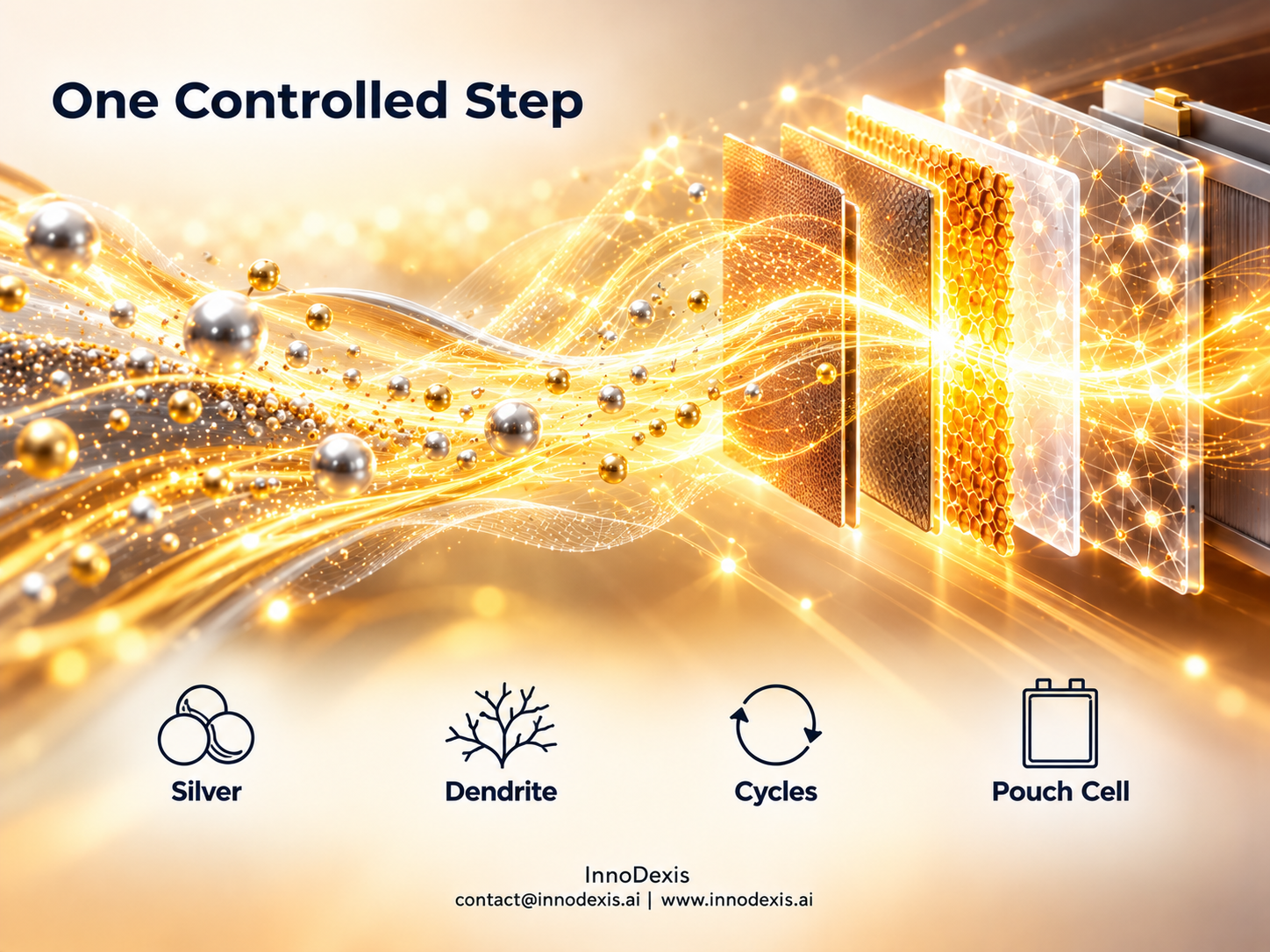
InnoDexis has published its latest Innovation Intelligence Report covering anode-free lithium metal batteries, analyzing one innovation from the Hong Kong University of Science and Technology (HKUST), published on 23 October 2026. The report reveals that a dynamic integrated interface engineering strategy, built on an AMI additive of silver ions paired with anions, achieved 467 Wh kg-1 specific energy in a pouch cell and 90% capacity retention after 200 cycles in a full coin cell, using a bare copper current collector and a quasi-solid-state electrolyte.
Key Findings
Pouch cells built with the strategy reached a specific energy of 467 Wh kg-1. This figure matches commercial battery metrics, and it was achieved in an anode-free design that does not require a pre-deposited lithium anode, which is what makes the result relevant to manufacturers targeting high-energy cells.
Full coin cells retained 90% of their capacity after 200 cycles. The result points to improved cycling stability and reversibility, though cycle stability has so far been demonstrated only to 200 cycles at coin-cell level, which defines the current limit of the evidence.
The AMI additive releases silver ions and anions that perform several functions in one controlled process after cell assembly. It enhances the lithiophilicity of the current collector, forms a dual-layered SEI with an organic-rich inner layer and inorganic-rich outer layer, and triggers electrolyte polymerization into a quasi-solid gel, mitigating dendrite growth.
The approach differs from standard lithiophobic copper collectors and single-purpose additive strategies, because one additive carries out multiple synergistic functions. It works on a bare copper current collector, which simplifies conventional manufacturing by relying on post-assembly interface formation. Eliminating pre-deposited lithium anodes also simplifies battery manufacturing workflows, and manufacturing scalability is rated high.
Both coin cell and pouch cell prototypes are operational. Commercial readiness is rated low-to-medium, with 3 to 5 years required for commercial pilot validation and manufacturing integration. Early experimental validation in pouch cells shows clear momentum toward pilot-scale testing.
Strategic Insight and Trend Analysis
The dominant trend in this research is a move from single-purpose battery additives toward integrated, multi-function interface engineering that acts after cell assembly. Shao Minhua, who leads the research group, states that the key is not simply adding a silver salt or a polymerization initiator. The AMI releases multiple functions through a controlled process, modifying the current collector, building an anion-derived solvation structure and forming the organic-inner and inorganic-outer SEI in one step.
This matters because it addresses the fundamental instability and dendrite problems on bare copper current collectors in anode-free cells. The result is highly reversible lithium plating and stripping in a quasi-solid-state configuration, which pushes quasi-solid-state batteries toward commercial viability with high specific energy. If it holds at scale, the approach could displace conventional lithium-ion and heavy lithium-metal anode architectures by offering lighter, safer anode-free alternatives with simplified assembly.
The evidence also carries clear boundaries. Concept risk is low, but long-term validation risk is moderate, covering extended cycle life and large-scale manufacturing cost. Potential degradation or uneven breakdown of the quasi-solid SEI gel over long-term operation is the principal technical risk, and maintaining stable interface integrity across multi-hundred charge-discharge cycles remains an open research gap.
Competition is moving quickly, with rapid development in solid-state and advanced lithium-ion technologies. The strategic question is therefore whether a post-assembly manufacturing shortcut can be validated before those alternatives close the gap.
Global and Industry Implications
For corporates and R&D teams, the strategy is positioned for direct technology transfer or licensing to battery manufacturers targeting high-energy density cells. Markets demanding high specific energy, including electric vehicles and consumer electronics, are the identified opportunity, with electric aviation power units and lightweight high-capacity portable electronics named as emerging applications. Scale-up testing in multi-layer pouch cells is the next evidence these teams will need.
For investors and capital allocators, the post-assembly transformation of bare copper collectors is described as a manufacturing shortcut and an attractive target for battery chemistry licensing. The risks are specific: commercial readiness is low-to-medium, pilot validation needs 3 to 5 years, and the cost and availability of the specialty AMI additive at scale are unresolved. Rapid development in competing solid-state and advanced lithium-ion technologies is the main threat.
For policymakers and national innovation bodies, no regulatory approval is required at present, but standard industrial battery safety approvals and lifecycle certifications will be needed before commercial release of this novel quasi-solid-state chemistry. Certification pathways for such chemistries will shape how quickly validated cells can reach the market.
InnoDexis Statement
“Moving interface formation into one controlled step after cell assembly turns the main instability of anode-free lithium cells into a manufacturing advantage, and long-cycle validation in larger formats is now the deciding test,” noted InnoDexis in its latest intelligence report.
Conclusion
The next milestones to watch are long-cycle degradation testing beyond 200 cycles, scale-up of pouch cell size for pilot manufacturing evaluation, and multi-layer pouch cell testing under real-world operating temperature ranges. Whether the dynamic interface stays stable across multi-hundred charge-discharge cycles will determine how far the approach advances. InnoDexis will continue to track quasi-solid-state electrolytes, anode-free lithium batteries and energy density optimization as this field develops. The complete Anode-Free Lithium Metal Battery Interface Engineering Innovation Intelligence Report is available to InnoDexis subscribers and enterprise clients.
About InnoDexis
InnoDexis is a real-time innovation intelligence platform connecting scientific discovery to commercial opportunity. Powered by InnoGraph, its proprietary innovation knowledge graph, the platform maps technologies across the entire lifecycle, from early-stage research (TRL 1) to market deployment (TRL 9), connecting researchers, institutions, startups, companies, products and emerging opportunities.
Covering 40+ specialised industry segments and 360 technology areas, InnoDexis delivers innovation tracking, research discovery, product and startup intelligence, investment insights, and AI-powered reports. Its mission is to bridge the gap between scientific discovery and real-world impact.
InnoDexis — From Lab to Market: Real-Time Innovation Intelligence.