Anhydrous Drug Delivery Achieves ~90% Tumor Elimination in Liver Cancer Treatment
A dry-formulation approach to chemoembolisation demonstrates significantly higher tumor response and survival outcomes compared to conventional liquid-based methods.
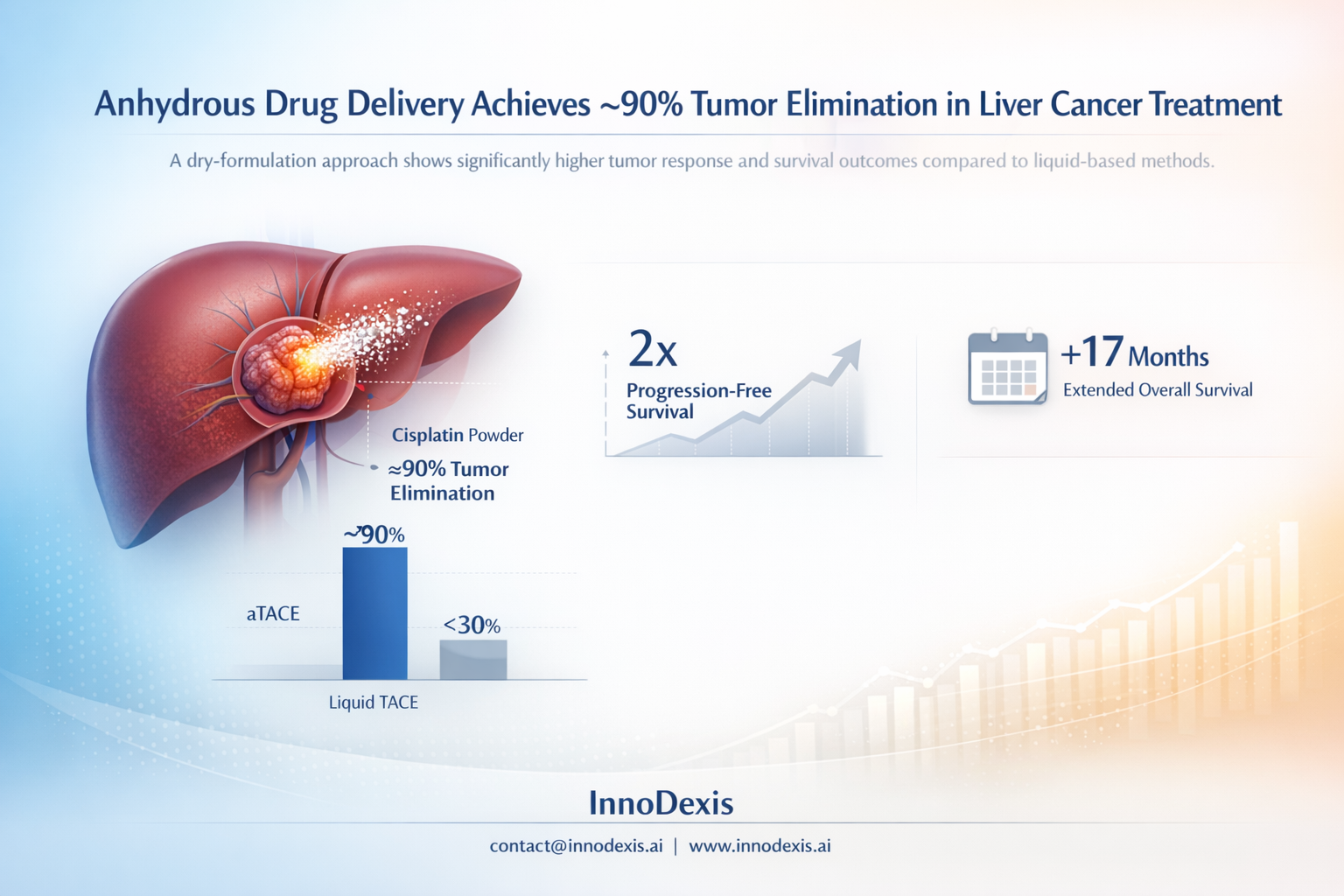
InnoDexis has published its latest Innovation Intelligence Report covering advancements in liver cancer treatment, analyzing emerging drug delivery approaches in hepatocellular carcinoma (HCC). The report reveals that researchers at The Chinese University of Hong Kong developed an anhydrous transarterial chemoembolisation (aTACE) method using cisplatin powder, achieving approximately 90% complete tumor elimination. Compared to conventional liquid-based delivery, which reports less than 30% tumor elimination, the findings indicate that drug delivery format and retention within tumors may play a critical role in improving therapeutic outcomes and extending patient survival.
Key Findings
Researchers at The Chinese University of Hong Kong developed an anhydrous TACE (aTACE) approach that replaces conventional liquid chemotherapy delivery with a dry cisplatin powder formulation. This method represents a shift in how chemotherapeutic agents are delivered directly to tumors in hepatocellular carcinoma treatment.
The clinical outcomes associated with this approach show a substantial increase in tumor response. Approximately 90% complete tumor elimination was reported using the anhydrous method, compared to less than 30% observed with standard liquid-based chemoembolisation techniques.
Survival metrics also indicate measurable improvement. Progression-free survival was reported to have doubled under the aTACE approach, while median overall survival increased by more than 17 months, suggesting extended patient benefit beyond initial tumor response.
Long-term outcomes further reflect the impact of the delivery method. Three-year progression-free survival rates were reported to have tripled compared to conventional approaches, indicating sustained therapeutic effectiveness over time.
A central mechanism underlying these results is higher drug retention within the tumor. The dry formulation allows for sustained-release behavior and localized concentration of the chemotherapeutic agent, reducing washout effects commonly associated with aqueous delivery systems.
Strategic Insight and Trend Analysis
The development of anhydrous chemoembolisation reflects a broader shift in oncology innovation from molecule discovery toward delivery optimization. While traditional approaches have focused on identifying new drugs, the aTACE method demonstrates that modifying how existing drugs are delivered can significantly influence treatment outcomes.
Conventional transarterial chemoembolisation relies on aqueous formulations, which can lead to rapid dispersion and reduced drug retention within the tumor microenvironment. The anhydrous approach introduces a different delivery dynamic, enabling sustained exposure of tumor cells to the therapeutic agent.
This shift toward high-retention, localized drug delivery aligns with a growing emphasis on precision treatment strategies. By concentrating the drug within the tumor while limiting systemic exposure, such approaches may improve efficacy while potentially reducing side effects.
The findings also suggest that physical and chemical properties of drug formulations—such as solubility and release kinetics—are becoming critical variables in treatment design. This represents an expansion of innovation focus beyond pharmacology into formulation science and delivery engineering.
If validated across larger clinical populations, this model could influence treatment protocols not only in hepatocellular carcinoma but also in other solid tumors where localized delivery is feasible. The approach indicates that improvements in therapeutic outcomes may be achieved through re-engineering existing treatment modalities rather than solely developing new compounds.
Global and Industry Implications
For corporates and R&D teams in pharmaceuticals and medical technology, the results highlight the importance of drug delivery innovation as a pathway to improving clinical outcomes. Reformulating existing drugs for higher retention and sustained release may offer an alternative to developing entirely new therapies.
For investors and capital allocators, the observed improvements in tumor response and survival metrics suggest that delivery-focused innovations could represent a distinct opportunity within oncology. Technologies that enhance the effectiveness of established drugs may reduce development timelines compared to new molecule discovery.
For policymakers and healthcare systems, advancements that improve treatment efficacy for patients who are not eligible for surgery may have implications for clinical guidelines and treatment accessibility. Enhanced local therapies could contribute to better outcomes in intermediate-stage liver cancer populations.
InnoDexis Statement
“The findings indicate that drug delivery architecture can significantly influence therapeutic outcomes, positioning formulation and retention strategies as a critical dimension of innovation in oncology,” noted InnoDexis in its latest intelligence report.
Conclusion
The development of anhydrous chemoembolisation using cisplatin powder introduces a new perspective on liver cancer treatment by emphasizing delivery efficiency over molecular innovation. With reported improvements in tumor elimination and survival outcomes, the approach highlights the potential of high-retention, localized therapies in oncology. As further validation emerges, drug delivery strategies may play an increasingly central role in shaping treatment standards across solid tumors. The complete Liver Cancer Drug Delivery Innovation Intelligence Report is available to InnoDexis subscribers and enterprise clients.
About InnoDexis
InnoDexis is a global Innovation Intelligence platform that tracks, analyzes, and interprets breakthrough innovations, prototypes, and emerging technologies across industries and countries. Its intelligence helps corporates, investors, and policymakers understand the true structure and direction of global innovation. Learn more at innodexis.ai.