AI Thermal Imaging Predicts Diabetic Foot Ulcer Healing at First Visit, Not After Four Weeks, as RMIT’s THERMUL Is Tested in 110 Patients
THERMUL, a smartphone-based tool from RMIT University, analyzes heat patterns in thermal images taken at a patient’s first visit to identify diabetes-related foot ulcers at risk of delayed healing.
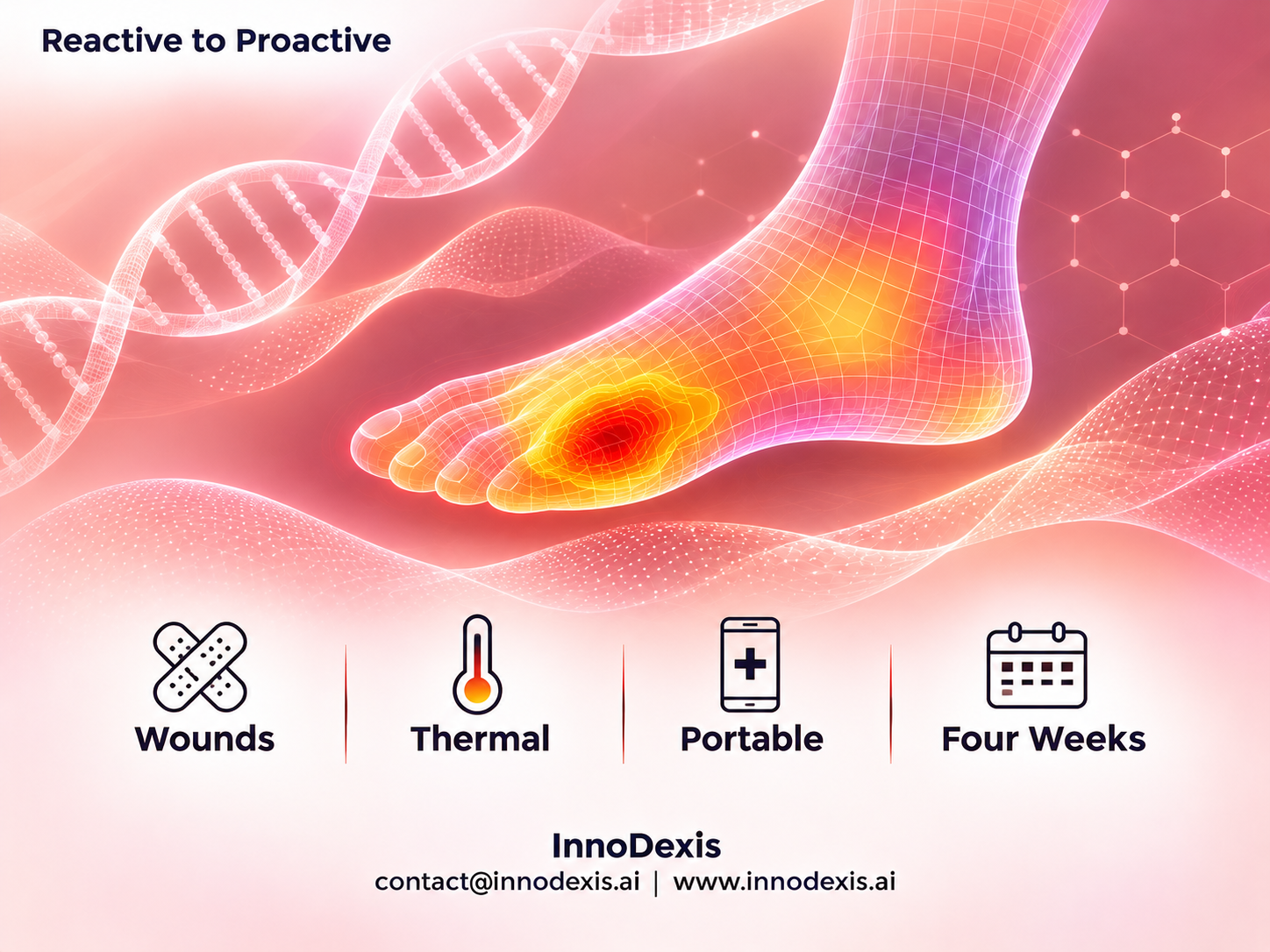
InnoDexis has published its latest Innovation Intelligence Report covering AI-enabled wound care diagnostics, analyzing one innovation from Australia, published on 16 November 2026. The report reveals that RMIT University researchers and their partners have developed THERMUL, a smartphone-based AI thermal imaging tool that predicts the healing risk of diabetes-related foot ulcers at a patient’s initial presentation, rather than after the four weeks of observation set out in standard clinical guidelines, in a clinical study of 110 patients, with the tool now progressing through further validation.
Key Findings
THERMUL predicts diabetes-related foot ulcer healing risk at a patient’s initial presentation. It analyzes heat patterns in thermal camera images captured at the first visit to identify wounds likely to suffer delayed healing. Standard clinical guidelines require four weeks of observation, so earlier identification allows clinicians to start interventions and escalate care sooner, reducing the risk of infection, hospitalizations and amputations.
The evidence comes from a clinical study of 110 patients. Thermal imaging was captured at presentation, at 2 weeks and at 4 weeks, and healing was assessed at 12 weeks. The study took place across hospital settings, and the tool is rated at medium commercial readiness while further validation continues.
The tool is portable and non-contact, built on a smartphone interface and a lightweight thermal camera. This supports clinical decision-making in regional, rural and remote diabetes outreach care, and the low-cost hardware is what makes field deployment realistic.
The problem it addresses is large. Diabetes-related foot disease costs the Australian health system an estimated $875 million annually, and diabetes affects 500 million people globally. Earlier risk identification targets one of the main cost drivers in that burden.
The evidence also has limits. The 110-patient cohort is relatively small, and larger multi-center prospective studies are required to validate that the AI generalizes across diverse patient populations. Thermal heat patterns must also stay consistent across varying environmental and patient conditions.
Strategic Insight and Trend Analysis
The dominant trend in this research is a shift in diabetic foot management from reactive monitoring to proactive early-stage intervention. Standard guidelines wait four weeks to assess healing progress. THERMUL moves the prediction point to the first clinical presentation, using AI analysis of heat patterns, which changes when a clinician can act on a wound that is likely to heal slowly.
This matters because it expands specialist-level decision support beyond specialist clinics. A portable, non-contact tool can be used in regional, rural and remote outreach care, and the research identifies telehealth and home-based chronic wound management as emerging applications. Immediate diagnostic guidance on presentation could disrupt traditional observational wound care timelines, reducing hospital care costs and specialist referral delays.
The route to deployment has clear conditions. The primary risks are regulatory certification and clinical validation across diverse patient cohorts, and approval as Software as a Medical Device is required, for example from the TGA in Australia. Variability in skin thermal signatures and ambient conditions could affect predictive accuracy, and clinicians accustomed to the standard four-week monitoring guidelines may be slow to adopt a new approach. The tool also depends on integrating an external thermal camera with a smartphone.
A multi-institutional partnership gives the work a base for that validation, linking RMIT and the University of Melbourne with St Vincent’s Hospital Melbourne, Austin Health, Bolton Clarke, the Royal Flying Doctor Service Victoria, the Australian Centre for Accelerating Diabetes Innovations and the commercial partner Software Medical Devices Pty Ltd.
Global and Industry Implications
For corporates and R&D teams, the research points to direct translation into clinical software devices for remote health networks, aged care providers and hospital outpatient clinics. Scaling the algorithm on mobile operating platforms and securing supply of lightweight, smartphone-compatible thermal imaging hardware are the practical requirements.
For investors and capital allocators, the timeline is 1 to 3 years for additional validation, regulatory filing and potential clinical deployment. THERMUL is identified as a target for strategic health-tech acquisition or investment once validation finishes, given a cost driver of $875 million annually in Australia. Regulatory approval delays and slow adoption in traditional healthcare workflows are the main threats.
For policymakers and national innovation bodies, the tool needs Software as a Medical Device approval from the relevant authorities. The potential gains are lower public healthcare costs from amputations and hospitalizations, expansion of regional and remote telehealth services, and improved access to timely care for people who live far from specialist clinics.
InnoDexis Statement
“Moving diabetic foot ulcer prediction from week four to the first visit turns thermal imaging into a decision-support tool for remote care, and larger multi-center validation now determines whether early intervention can scale,” noted InnoDexis in its latest intelligence report.
Conclusion
The next milestones to watch are completion of the ongoing validation studies, larger multi-center prospective studies to confirm generalization across diverse populations, and the regulatory filing needed for Software as a Medical Device approval. Work with Software Medical Devices Pty Ltd to establish a commercial software pipeline will show how quickly the tool reaches remote health networks and outpatient clinics. InnoDexis will continue to track AI-enabled diagnostics, thermal imaging and remote healthcare as this field develops. The complete AI Thermal Imaging for Diabetic Foot Ulcer Prediction Innovation Intelligence Report is available to InnoDexis subscribers and enterprise clients.
About InnoDexis
InnoDexis is a real-time innovation intelligence platform connecting scientific discovery to commercial opportunity. Powered by InnoGraph, its proprietary innovation knowledge graph, the platform maps technologies across the entire lifecycle, from early-stage research (TRL 1) to market deployment (TRL 9), connecting researchers, institutions, startups, companies, products and emerging opportunities.
Covering 40+ specialised industry segments and 360 technology areas, InnoDexis delivers innovation tracking, research discovery, product and startup intelligence, investment insights, and AI-powered reports. Its mission is to bridge the gap between scientific discovery and real-world impact.
InnoDexis — From Lab to Market: Real-Time Innovation Intelligence.