AI Rewires the US Healthcare Insurance System as 26 Breakthrough Innovations Signal Structural Transformation
A cross-institutional analysis reveals artificial intelligence moving from experimental deployment to operational infrastructure across claims management, predictive risk modelling, fraud detection, and remote patient monitoring.
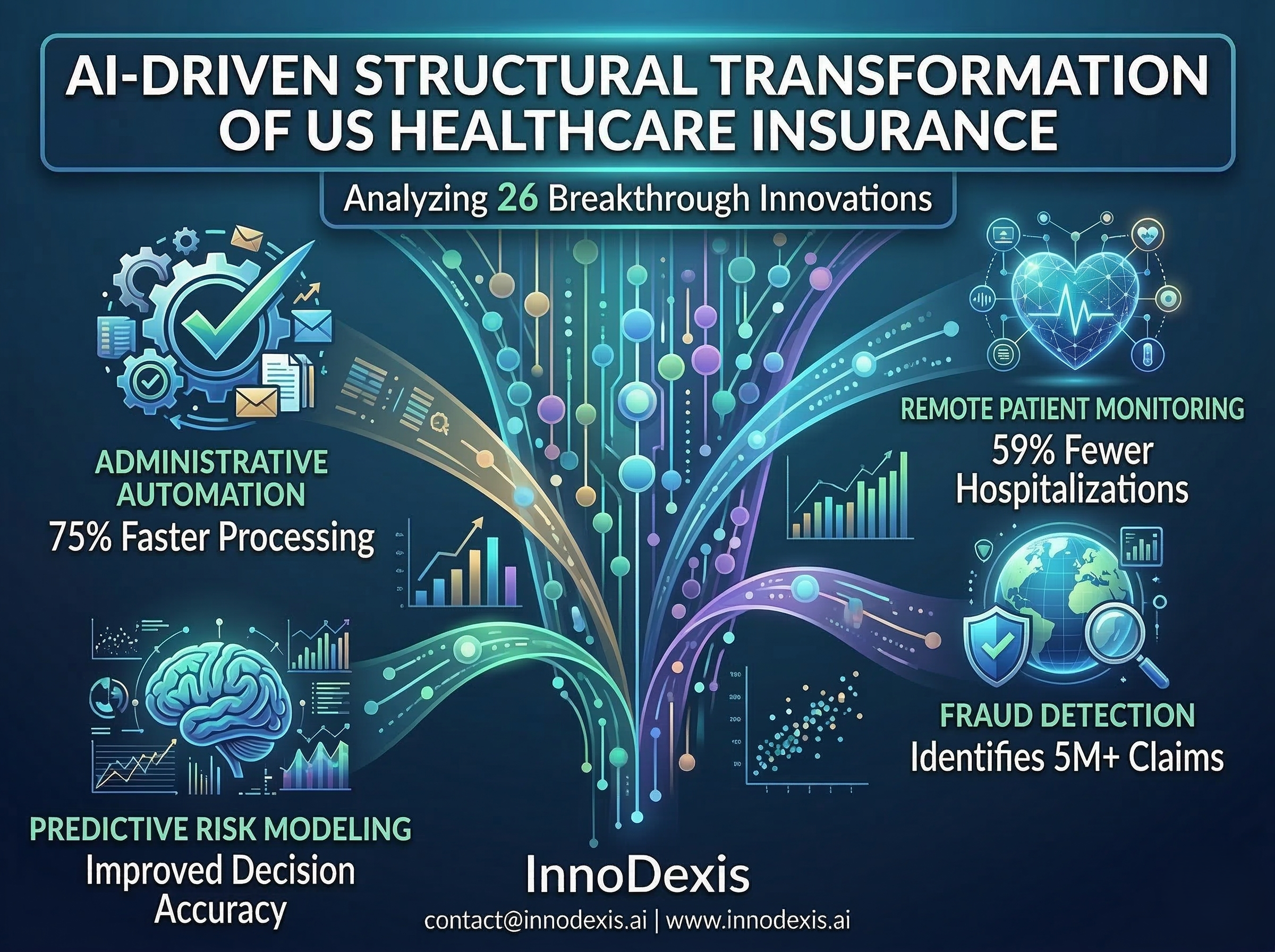
InnoDexis has published its latest Innovation Intelligence Report covering artificial intelligence in US healthcare insurance, analyzing 26 innovations across 18 leading academic institutions and health systems during the period January 2024 to March 2026. The report reveals that artificial intelligence is rapidly becoming the operational backbone of the American health insurance ecosystem. Innovations spanning claims management, predictive risk intelligence, remote patient monitoring, and fraud detection demonstrate a structural shift from manual administrative processes toward data-driven insurance infrastructure capable of transforming both operational efficiency and clinical outcomes.
Key Findings
The dataset highlights the emergence of artificial intelligence as a foundational operational technology within the healthcare insurance value chain. Across the 26 innovations analyzed, seven application domains were identified, including predictive risk modeling, remote patient monitoring, clinical decision support, generative AI administration tools, fraud detection, and disaster-related insurance analytics. This distribution reflects the expansion of AI beyond narrow clinical applications toward enterprise-level insurance operations.
Administrative automation has emerged as one of the most immediate transformation areas. A major deployment of AI-enabled prior authorization technology reduced review times to approximately four to five minutes, representing a 75% improvement over typical industry processes. This demonstrates the potential for AI systems to reduce administrative burdens while increasing processing speed across large health system networks.
Evidence supporting AI-enabled remote patient monitoring has also reached actuarial thresholds relevant to insurance coverage decisions. One large-scale monitoring program involving more than 1,700 high-risk patients reported a 59% reduction in hospitalizations and a documented financial return exceeding $12 million. These results indicate that continuous monitoring technologies can significantly reduce high-cost hospital admissions while enabling earlier intervention for chronic conditions.
Fraud detection represents another major opportunity. Medicare fraud alone is estimated to cost approximately $60 billion annually. A machine-learning framework capable of identifying fraudulent claims without requiring pre-labeled training data demonstrated strong performance on datasets containing more than five million Medicare Part D claims. This approach addresses one of the major barriers to fraud detection systems: the difficulty of generating labeled fraud datasets at scale.
Predictive risk modeling is also advancing through the integration of clinical and insurance claims data. Machine learning frameworks analyzing more than 10,000 patients demonstrated improved prediction accuracy for disease progression when clinical records and claims data were combined. These systems enable earlier detection of high-risk patients and support proactive intervention strategies for insurers and healthcare providers.
Strategic Insight and Trend Analysis
Taken together, the findings point to a structural transformation of the health insurance industry driven by converging technological and regulatory forces. Historically, insurance operations have relied on retrospective claims analysis, manual administrative workflows, and fragmented data systems. The innovations identified in this dataset indicate that the industry is transitioning toward predictive, automated, and continuously monitored care models.
Artificial intelligence is enabling this transition by integrating three previously separate information layers: clinical medical data, insurance claims records, and real-time patient monitoring signals. When these datasets are combined, insurers gain the ability to move beyond reactive cost management toward predictive population health strategies. Predictive risk models can identify emerging medical conditions earlier, while remote monitoring technologies enable continuous care outside hospital settings.
Another key trend is the shift from facility-centered healthcare delivery toward distributed care models supported by telehealth and monitoring technologies. Remote patient monitoring platforms equipped with connected medical devices now allow insurers and healthcare providers to monitor patients continuously in their homes. This reduces hospital utilization while generating new streams of clinical data for risk prediction and early intervention.
The analysis also highlights the growing importance of AI governance and human-machine collaboration. Research examining AI-assisted decision making shows that human performance can improve significantly when AI predictions are accurate, but can deteriorate when algorithms are incorrect and users rely too heavily on automated recommendations. This finding underscores the need for structured human-AI collaboration frameworks rather than fully automated decision systems.
Global and Industry Implications
For corporates and R&D teams, the rise of AI-enabled insurance infrastructure signals an expanding demand for technologies that integrate healthcare data, predictive analytics, and operational automation. Companies developing clinical decision systems, patient monitoring technologies, and data integration platforms may play a central role in the next generation of healthcare insurance systems.
For investors and capital allocators, the innovation landscape reveals a growing pipeline of AI-driven healthcare platforms transitioning from research validation to commercial deployment. Remote patient monitoring, predictive risk modeling, and administrative automation technologies represent some of the most commercially scalable segments within the health insurance technology ecosystem.
For policymakers and regulators, the expansion of AI within insurance systems introduces new governance challenges related to algorithm transparency, regulatory oversight, and demographic bias mitigation. As insurers deploy predictive risk systems and automated decision tools, regulatory frameworks will need to evolve to ensure fairness, safety, and accountability in AI-driven healthcare decision making.
InnoDexis Statement
“The integration of clinical data, insurance claims information, and real-time patient monitoring is transforming health insurance from retrospective cost management into predictive population health intelligence,” noted InnoDexis in its latest intelligence report.
Conclusion
The AI in US Healthcare Insurance Innovation Intelligence Report demonstrates that artificial intelligence is rapidly reshaping the structure of health insurance operations. From automated claims management to predictive risk modeling and remote patient monitoring, the innovations identified in this analysis reveal an industry transitioning toward data-driven healthcare infrastructure.
As regulatory frameworks evolve and technology adoption accelerates, the coming decade will determine how effectively insurers integrate these capabilities into real-world care delivery systems. Monitoring emerging innovations across predictive analytics, clinical AI, and healthcare data integration will therefore remain essential for stakeholders seeking to understand the future direction of the health insurance industry.
The complete AI in US Healthcare Insurance Innovation Intelligence Report is available to InnoDexis subscribers and enterprise clients.
About Innodexis
InnoDexis is a global Innovation Intelligence platform that tracks, analyzes, and interprets breakthrough innovations, prototypes, and emerging technologies across industries and countries. Its intelligence helps corporates, investors, and policymakers understand the true structure and direction of global innovation. Learn more at innodexis.ai.