AI-Mentioning Corporate Records Carry High Momentum at 19.0% Against 9.1% for Others but Contract Awards Show No Lift at 16.7% Against 17.0%
An analysis of 1,270 AI-mentioning records among 4,840 corporate records finds that AI is associated with the biggest momentum gains in announcements that lack other evidence, such as product updates at 9.7 percent against 2.1 percent, while physical AI reaches 41.5 percent High momentum and computer vision none.
InnoDexis has published its latest Innovation Intelligence Report covering AI across corporate announcement types, analyzing 1,270 AI-mentioning records, 26.2 percent of 4,840 corporate records, across 7 AI types, 18 announcement types and 14 technology families during the 1–29 September 2026 observation window. The report reveals that AI lifts the announcements that lack evidence and adds nothing to those that already have it: AI-mentioning records carry High market momentum 19.0 percent of the time against 9.1 percent, yet contract awards show 16.7 percent against 17.0 percent.
Key Findings
AI is in a quarter of announcements. Records mentioning AI are 1,270, 26.2 percent, and they carry High momentum 19.0 percent of the time against 9.1 percent for others and score 5.66 against 4.79, though AI is detected by keyword and momentum is analyst-assigned.
The lift is largest where evidence is missing. High momentum is 9.7 percent against 2.1 percent in product updates, 17.5 against 6.2 in launches, 21.2 against 8.5 in partnerships, 22.7 against 7.4 in market expansions and 27.8 against 10.4 in acquisitions.
AI adds nothing where an external party has acted. Contract awards show 16.7 percent against 17.0 percent, awards 16.4 against 16.7 and regulatory milestones 25.0 against 23.5, so AI is a weaker signal than a trial, a contract or an approval.
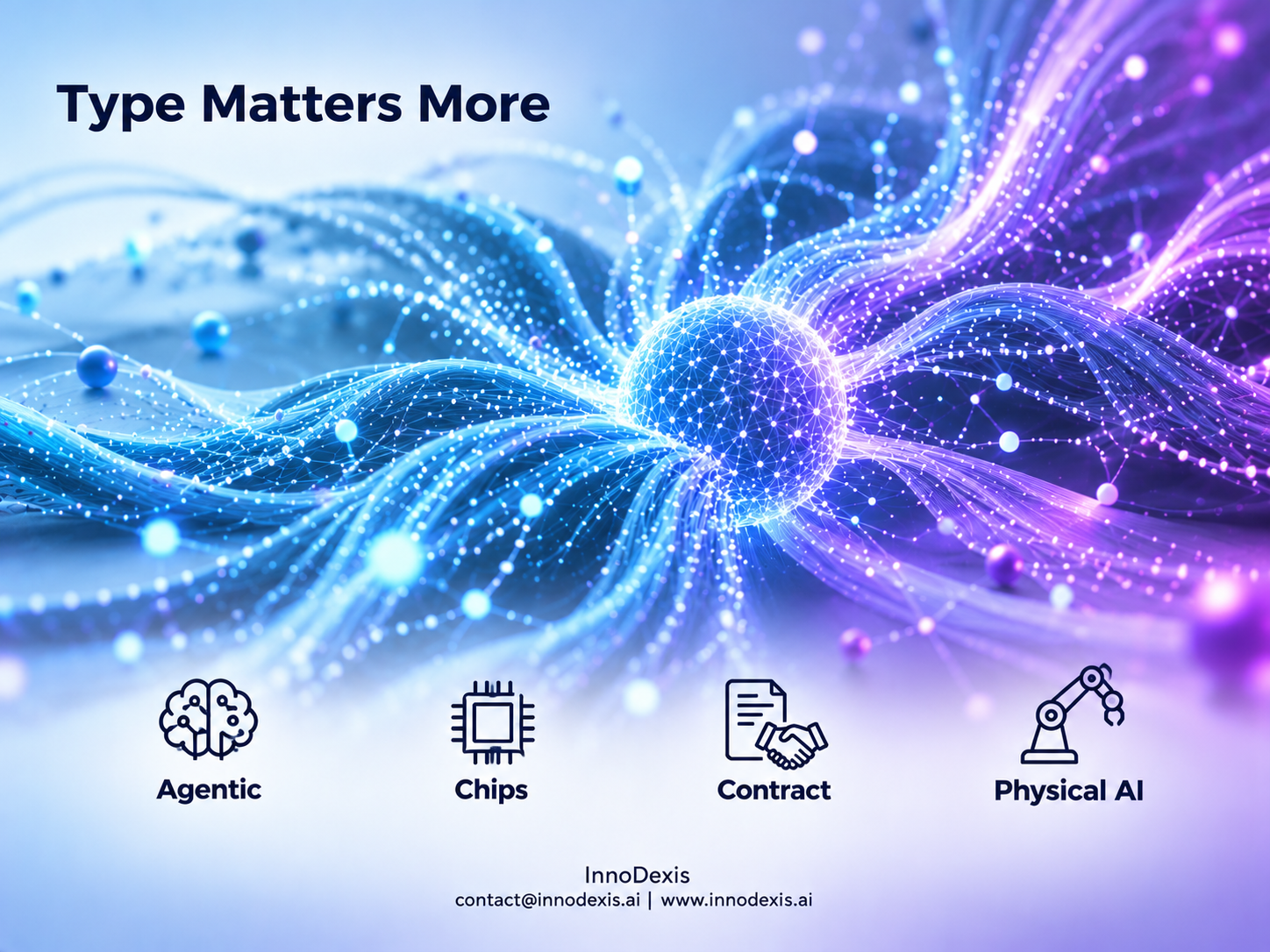
AI type matters more than the label. Physical AI carries 41.5 percent High momentum, AI infrastructure and chips 39.2, agentic 32.3 and generative 29.4, against governance and security at 21.9, predictive ML and analytics at 11.8 and computer vision at 0.0 on 8 records.
AI moves into physical families and start-ups lead. The 376 AI records outside the AI family show 36.5 percent High momentum in semiconductors against 9.5 and 36.8 in energy against 17.9, and 46.3 percent of start-up records mention AI against 20.1 percent of large corporates. Funding rounds are the most AI-heavy type at 44.7 percent.
Strategic Insight and Trend Analysis
The defining structural finding is that AI works as substitute evidence. Where an announcement has no external validation, AI supplies a reason to pay attention and the stream rewards it, while where validation exists AI adds little, so the lift is largest in the same announcement types that score lowest overall. AI appears in 73.2 percent of AI-family records, so “AI-powered” is no longer a differentiator on its own, and AI mentions concentrate in funding rounds, awards, product updates, launches and strategic alliances.
AI moves into physical families. In semiconductors, energy, therapeutics and robotics, AI records carry two to four times the momentum of non-AI records, with examples including Huawei’s Peerium, CATL with VNET, Insilico Medicine, Basecamp Research, Nscale with Figure and KoiReader’s physical-AI yard intelligence, and the older, commoditised forms of AI, predictive analytics and computer vision, no longer distinguish an announcement.
Several cautions apply. Momentum is analyst-assigned and may itself reward AI language, which is why the finding is framed as association, AI is detected by keyword so a title mention may describe a minor feature, type tags are narrower, samples per announcement type are moderate at 31 to 139, and one month supports no trend. AI shares are similar across major systems, from India at 31.7 percent to South Korea at 22.2 percent, and AI mentions are least common in regulatory approvals at 3.2 percent, debt financing at 5.6 percent and clinical trials at 7.1 percent.
Global and Industry Implications
For corporates and R&D teams, add evidence rather than relying on the AI label, apply AI in physical products and name the AI type and its measured outcome, since physical, infrastructure, agentic and generative AI carry 29 to 42 percent High momentum. Pairing agents with outcomes and controls is the named priority, and start-ups should differentiate with a type and an outcome, since 46.3 percent of start-up records mention AI.
For investors and capital allocators, discount the AI label in validated events and weight the AI type, asking what the AI does and how it is measured. Named opportunities include Huawei, Nscale, Insilico Medicine, Basecamp Research, KoiReader and Synopsys, and AI-heavy funding rounds carry 54.5 percent High momentum against 36.8 percent for non-AI rounds.
For policymakers and national innovation bodies, AI claims need standards, and AI management and safety certification is the named priority, with ISO/IEC 42001 claimed rarely. AI governance and security is an emerging category with 32 records at 21.9 percent High momentum, including BigID AgentIQ, AIBound with Ingram Micro and Eagle Cloud.
InnoDexis Statement
“AI lifts the announcements that lack evidence and adds nothing to those that already have it — the type of AI and the outcome it measures matter more than the label,” noted InnoDexis in its latest intelligence report.
Conclusion
Because AI is detected by keyword, momentum is analyst-assigned and may reward AI language, type tags are narrower and one month supports no trend, the findings are associations rather than causes. The signals to watch are whether the gap between AI and non-AI records stays near 10 points, whether AI share rises above 35 percent while the lift falls below 5 points, whether AI-labelled products gain regulatory clearance, and whether AI governance standards such as ISO/IEC 42001 are adopted. The complete AI Across Announcement Types Report September 2026 is available to InnoDexis subscribers and enterprise clients.
About InnoDexis
InnoDexis is a real-time innovation intelligence platform connecting scientific discovery to commercial opportunity. Powered by InnoGraph, its proprietary innovation knowledge graph, the platform maps technologies across the entire lifecycle, from early-stage research (TRL 1) to market deployment (TRL 9), connecting researchers, institutions, startups, companies, products and emerging opportunities.
Covering 40+ specialised industry segments and 360 technology areas, InnoDexis delivers innovation tracking, research discovery, product and startup intelligence, investment insights, and AI-powered reports. Its mission is to bridge the gap between scientific discovery and real-world impact.
InnoDexis — From Lab to Market: Real-Time Innovation Intelligence.