AI Infrastructure Accounts for 3.2% of 10,133 Corporate Records and 26.2% of Top-Decile Results as Energy Storage Leads All Stack Layers at 6.81 and Sovereign Capacity Scores Highest of Any Sub-Thread
A quick-cycle analysis of 324 AI compute infrastructure records from 1 July to 22 August 2026 finds that the binding constraint has migrated from silicon to power, that 64% of announcing entities are suppliers rather than hyperscalers, and that thermal management carries the highest momentum-to-attractiveness divergence in the cluster.
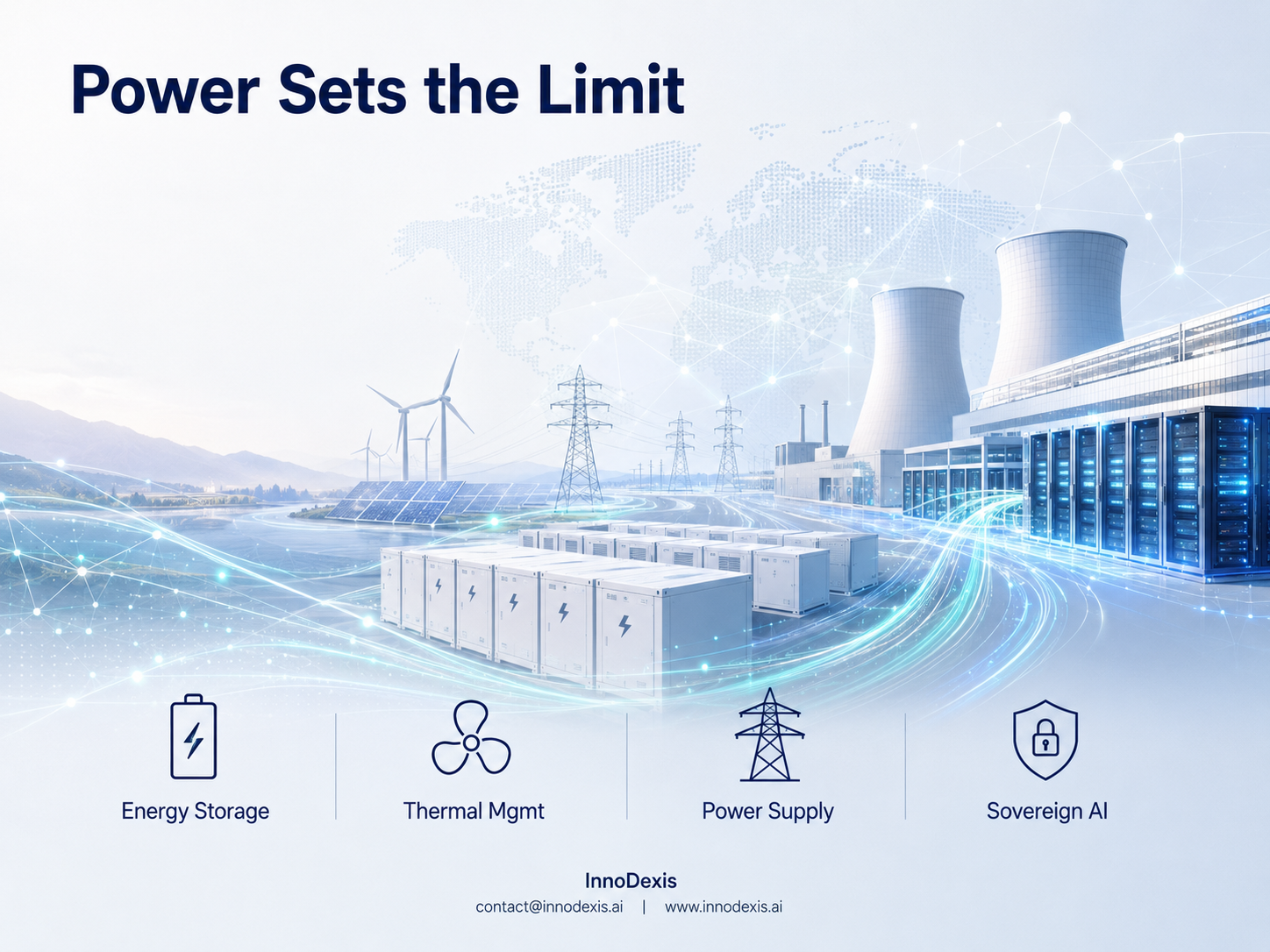
InnoDexis has published its latest Corporate Intelligence Report — The AI Buildout Has Stopped Being a Compute Story — analyzing 324 AI compute infrastructure records extracted from 10,133 validated Corporate-stream announcements during the period from 1 July to 22 August 2026. The report reveals that a cluster representing 3.2% of the validated corpus accounts for 26.2% of its top-decile records, with a mean InnoDexis score of 6.40 against a corpus baseline of 5.26 — a gap that holds on every quality dimension measured. The strength inside the cluster concentrates not in silicon or software but in power supply, energy storage, thermal management, and land, with 71% of cluster records at TRL 8–9 confirming the technology is shipping rather than proposed.
Key Findings
Energy storage and uninterruptible power supply leads all eight stack layers on every quality measure, recording the highest mean score in the cluster at 6.81, more than two-thirds of rated records marked High on investment attractiveness, and the strongest momentum reading anywhere in the corpus across the window. Power generation and supply follows at 6.45 with 55% High investment attractiveness. Silicon and memory at 6.75 scores second overall but sits behind the grid-edge layer on attractiveness — a ranking that directly inverts the assumption that compute is where the value concentrates in the AI buildout.
Thermal management and cooling is the cluster's most analytically distinctive layer and is explicitly identified in the report as underpriced. Cooling records score 6.24 with 53% High momentum but only 36% High investment attractiveness — the lowest attractiveness rate of any layer in the cluster. The report identifies this divergence as characteristic of a category the market has not yet learned to evaluate, pointing to immersion-cooling demonstrations, graphene thermal coatings passing 30,000-hour corrosion benchmarks, and ceramic additive manufacturing targeting the gas-turbine casting bottleneck as entries into a market whose size is being set by a thermal ceiling rather than a compute ceiling.
The cluster is unusually physical relative to the broader corpus. Across the full corpus, 17% of rated records describe a product with a hardware component; inside the AI infrastructure cluster the rate is 43%. The ESG divergence is sharper still — corpus-wide ESG-tagged records skew Social, while inside the cluster 82% of ESG tags are Environmental, because the environmental claim concerns megawatts, water draw, and heat rather than workforce programmes. Hardware-bearing announcements carry longer lead times, capital intensity, and supply-chain dependency, which the report identifies as precisely what makes them stronger forward indicators than software launches — a substation cannot be reversed in a quarter.
Sixty-four percent of cluster announcements originate from mid-size corporates, SMEs, and startups — entities selling into the buildout rather than commissioning it. Large corporates account for roughly a quarter. The report identifies this picks-and-shovels distribution as changing how the signal should be used: hyperscaler capital expenditure is visible in quarterly disclosures and priced into public equities long before it reaches an announcement feed, while the supplier layer is not. Xsight Labs raising upward of USD 300 million at a USD 2.8 billion valuation for next-generation AI and cloud networking silicon, ZincFive moving toward a public listing for nickel-zinc immediate-power systems serving data centres, and Siemens committing more than USD 200 million to US manufacturing for AI infrastructure each indicate which parts of the physical stack the buildout is currently straining.
Sovereign AI capacity forms a distinct sub-thread across 41 records scoring a mean of 6.90 — the highest sub-segment mean in the analysis — with 43% rated High on investment attractiveness. NAVER's partnership with Brookfield and NVIDIA on Korea's national AI factory infrastructure, the Orange–Morrison data-centre joint venture aimed at European digital autonomy, and sovereign deployments across Saudi Arabia and the Middle East's first sovereign AI facility together describe a market where the buyer is increasingly a state or state-adjacent champion and the specification includes jurisdictional control over where inference occurs. The report identifies this as the most consequential structural shift in the cluster, changing the buying centre, the sales cycle, the compliance surface, and the competitive set — suppliers able to satisfy data-sovereignty and national-security requirements compete in a structurally different market regardless of technical parity.
Strategic Insight and Trend Analysis
The most consequential structural finding of the AI infrastructure report is the confirmation that the binding constraint of the AI buildout has migrated from what the model can do to whether the machine that runs it can be powered, cooled, and sited. Energy Vault's agreement to deploy 1.25 gigawatts of integrated power infrastructure for hyperscaler AI facilities is a power-industry transaction wearing a data-centre label. Crusoe's partnership with Aalo Atomics targeting a nuclear-powered AI facility, Hedgehog USA's energy supply agreement for a Texas powered-land platform, and the revitalisation of a Department of Energy site in western Kentucky as a combined campus and dedicated energy project each describe the same constraint from different angles: compute is now sited where firm power can be secured, not where fibre and tax abatement happen to be favourable.
This migration has a structural consequence for how the cluster should be tracked. The segments carrying the highest attractiveness ratings — energy storage at 68% High and power generation at 55% High — are currently scored inside a data-centre frame. They warrant a distinct taxonomy branch and dedicated source coverage spanning utility filings, interconnection queues, and independent power producer announcements that sit largely outside the current corporate feed. The sovereign sub-thread reinforces the same argument: scoring at 6.90 with no structured flag in the schema, it is currently reconstructible only from free-text inspection of strategic importance and regulatory context fields, meaning its trajectory cannot be tracked as a trend line across cycles.
The TRL profile's double-peaked shape — 71% at TRL 8–9 confirming commercial scale, with 2.3 times the corpus share at TRL 4 — is characteristic of a category being rebuilt while it scales. New cooling chemistries, microreactor designs, and power-architecture concepts are entering the pre-pilot band at the same time the category is shipping revenue, which is the structural signature of a genuine transition rather than a single-wave technology cycle.
Global and Industry Implications
For corporates and R&D teams, the stack-layer quality ranking provides a directly actionable watchlist recalibration. Energy storage, UPS systems, power generation supply, and grid interconnection are where the highest attractiveness ratings concentrate — and they are currently under-covered relative to silicon and software layers that attract disproportionate analytical attention. The Meta and BlackRock data-centre venture at approximately USD 14 billion, the Bloom Energy fuel-cell deployment backed by Industrial Development Funding and Oaktree at USD 1.7 billion, and the 16-year Bitdeer AI and HPC data-centre lease at the Tydal campus in Norway at USD 4.7 billion each confirm that the long-duration, capital-intensive infrastructure commitment is at the power and siting layer — the part of the stack where supplier relationships are established years ahead of commercial operation.
For investors and capital allocators, the 94-record highest-conviction cohort — scoring 7 or above with High investment attractiveness — is the cluster's most actionable sourcing list, and the thermal management layer warrants specific attention as the most clearly underpriced category in the analysis. The 53% High momentum combined with 36% High investment attractiveness is the divergence signature the report identifies as characteristic of a category not yet understood by the market — the condition under which early-warning value is highest. Funding-round announcements appear at more than double the corpus rate at 5.2% against 2.3%, confirming capital is still entering the category rather than consolidating out of it. The geographic concentration at 81% US involvement is explicitly identified as a source-coverage map as much as an activity map, with Chinese, Indian, and Gulf buildout activity materially under-represented relative to real scale.
For policymakers and national innovation bodies, the sovereign capacity sub-thread at 41 records and a 6.90 mean score documents a structural shift in who is making AI infrastructure decisions and on what terms. The NAVER and Brookfield and NVIDIA Korea national AI factory, the DOE site revitalisation as a combined campus and dedicated energy project backed by Brookfield and NextEra, and the GlobalFoundries USD 300 million award letter of intent from the US Department of Commerce each represent public capital actively shaping where the physical infrastructure of AI is built — confirming that AI infrastructure is industrial policy operating under a technology label, and that the competitive set for any supplier is defined by jurisdictional compliance capability as much as technical performance.
InnoDexis Statement
"The AI buildout has stopped being a compute story — the segments carrying the highest investment attractiveness ratings are power, storage, and siting, and the organisations announcing them are suppliers the market has not yet priced, not hyperscalers whose capital expenditure was visible in last quarter's earnings call," noted InnoDexis in its latest intelligence report.
Conclusion
The AI Infrastructure Quick-Cycle Report establishes that a 3.2% slice of the Corporate stream carries 26.2% of its top-decile records, that value inside the cluster has migrated from the rack toward the power plant, and that sovereign AI capacity is the highest-scoring sub-segment in the analysis with the strongest case for structured tracking. Across 324 records from a validated corpus of 10,133 announcements, the evidence confirms energy storage at the top of every quality metric, thermal management as the cluster's most systematically underpriced layer, and 64% of announcing entities as suppliers whose signal precedes hyperscaler capital expenditure disclosure by months or quarters. As the sovereign sub-thread is tracked with a structured flag, thermal management attractiveness ratings are monitored for convergence with its momentum readings, and non-US source coverage is expanded to close the geographic gap, the AI infrastructure framework will provide the most precisely calibrated forward signal on physical buildout constraints the InnoDexis platform has yet produced. The complete AI Infrastructure Quick-Cycle Topic Report July to August 2026 is available to InnoDexis subscribers and enterprise clients.
About InnoDexis
InnoDexis is a global Innovation Intelligence platform that tracks, analyzes, and interprets breakthrough innovations, prototypes, and emerging technologies across industries and countries. Its intelligence helps corporates, investors, and policymakers understand the true structure and direction of global innovation. Learn more at innodexis.ai.