AI-Driven Predictive Freshness Models Shift Food Systems from Static Expiry Dates to Condition-Based Intelligence
A new AI model forecasting bacterial growth introduces measurable, real-time food freshness, signaling a transition from fixed labeling to dynamic, condition-aware systems.
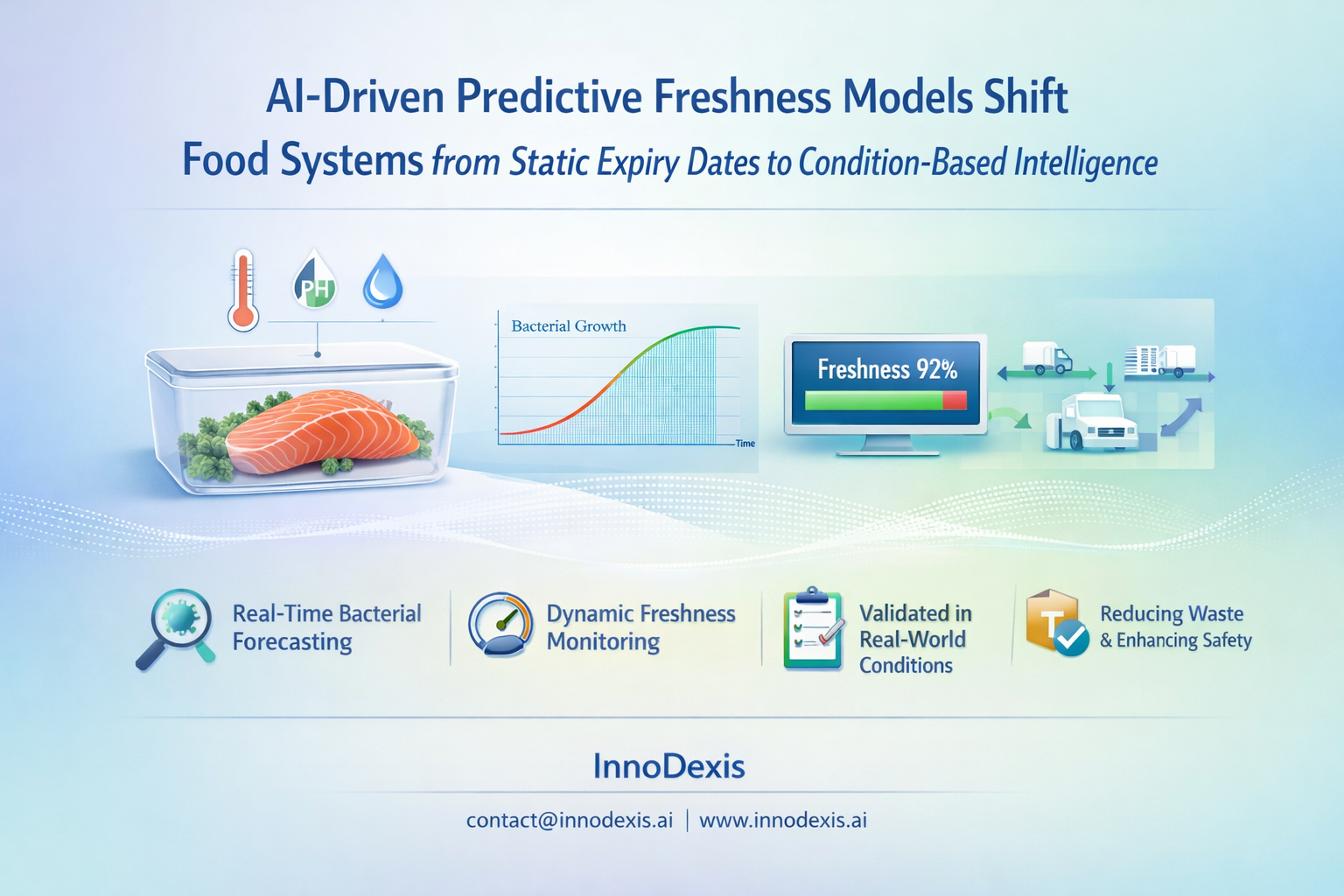
InnoDexis has published its latest Innovation Intelligence Report covering artificial intelligence applications in food systems, analyzing emerging innovations in predictive food safety and shelf-life optimization. The report highlights a model developed at Nanyang Technological University that forecasts bacterial growth under real-world conditions. The report reveals that food freshness, traditionally defined by static expiry labels, can now be dynamically predicted using biology-informed AI models that account for environmental and storage variables.
Key Findings
A biology-informed AI model has been developed to forecast bacterial growth patterns, including pathogens such as Salmonella, enabling a measurable and data-driven approach to food freshness. This represents a shift from estimation-based systems toward predictive microbiological modeling grounded in observed biological behavior.
The model incorporates context-aware variables such as temperature, acidity, and storage conditions, allowing freshness predictions to adapt dynamically to real-world environments. This approach contrasts with conventional fixed-date labeling, which does not account for variability across supply chains and storage contexts.
Validation of the model has been conducted using real food samples rather than controlled simulations, indicating alignment with practical, real-world conditions. This increases the reliability of predictive outputs and supports potential integration into operational food systems.
The innovation connects multiple system layers, including shelf life estimation, food safety monitoring, and energy optimization. By linking these components within a single predictive framework, the model demonstrates the potential for cross-functional impact beyond isolated food safety applications.
The transition from static “best-before” labels to dynamic freshness intelligence introduces a new framework for how food quality is defined and monitored. Freshness becomes condition-based rather than time-based, enabling more precise decision-making across the value chain.
Strategic Insight and Trend Analysis
The emergence of predictive freshness models indicates a broader shift toward condition-based intelligence systems in food and supply chain management. Traditional food labeling systems rely on standardized timelines that do not reflect the variability of real-world handling, transportation, and storage conditions. The introduction of AI-driven bacterial growth forecasting suggests that food systems are entering a phase where biological processes can be quantified and monitored dynamically.
This shift aligns with a wider trend of integrating artificial intelligence into physical systems to improve efficiency and reduce uncertainty. By incorporating environmental variables and biological data into predictive models, food freshness can be continuously recalibrated rather than predefined. This reduces reliance on conservative estimates that often lead to premature disposal.
The model also reflects increasing convergence between food science, artificial intelligence, and systems engineering. Rather than addressing food safety as a standalone problem, the approach integrates multiple dimensions, including microbial behavior, environmental conditions, and operational constraints. This indicates movement toward system-level optimization rather than isolated innovation.
The transition from time-based to condition-based frameworks suggests that food systems may become more adaptive and responsive. As predictive capabilities improve, the role of static labeling may diminish, replaced by real-time intelligence that reflects actual product conditions. This represents a structural evolution in how food quality, safety, and usability are defined.
Global and Industry Implications
For corporates and R&D teams, predictive freshness models present an opportunity to redesign product lifecycle management and quality assurance systems. Integration of condition-based intelligence could enable more precise inventory control, reduce waste, and improve operational efficiency across retail and distribution networks.
For investors and capital allocators, the convergence of artificial intelligence with food systems signals an emerging domain where efficiency gains are tied to measurable system improvements. Technologies that link safety, shelf life, and energy optimization may represent scalable opportunities within food technology and supply chain innovation.
For policymakers and national innovation bodies, the shift toward predictive freshness introduces implications for food labeling standards and regulatory frameworks. Existing guidelines based on fixed expiry dates may require adaptation to accommodate dynamic, data-driven systems that reflect real-time conditions.
InnoDexis Statement
“The transition from static expiry labeling to predictive freshness systems reflects a structural shift in how food quality is defined, measured, and managed across supply chains,” noted InnoDexis in its latest intelligence report.
Conclusion
The development of AI models capable of forecasting bacterial growth introduces a new paradigm in food system management, where freshness is no longer estimated but continuously evaluated. As condition-based intelligence replaces fixed timelines, opportunities emerge for more efficient logistics, reduced waste, and improved safety outcomes. The evolution of this approach will depend on integration across regulatory, commercial, and technological domains. The complete AI-Driven Food Freshness Innovation Intelligence Report is available to InnoDexis subscribers and enterprise clients.
About InnoDexis
InnoDexis is a global Innovation Intelligence platform that tracks, analyzes, and interprets breakthrough innovations, prototypes, and emerging technologies across industries and countries. Its intelligence helps corporates, investors, and policymakers understand the true structure and direction of global innovation. Learn more at innodexis.ai.