AI-Driven Cell Identification Advances Biological Research Through Scalable Image Analysis
A general-purpose AI model enables automated, large-scale cell identification across imaging types, reducing manual constraints in biological research workflows.
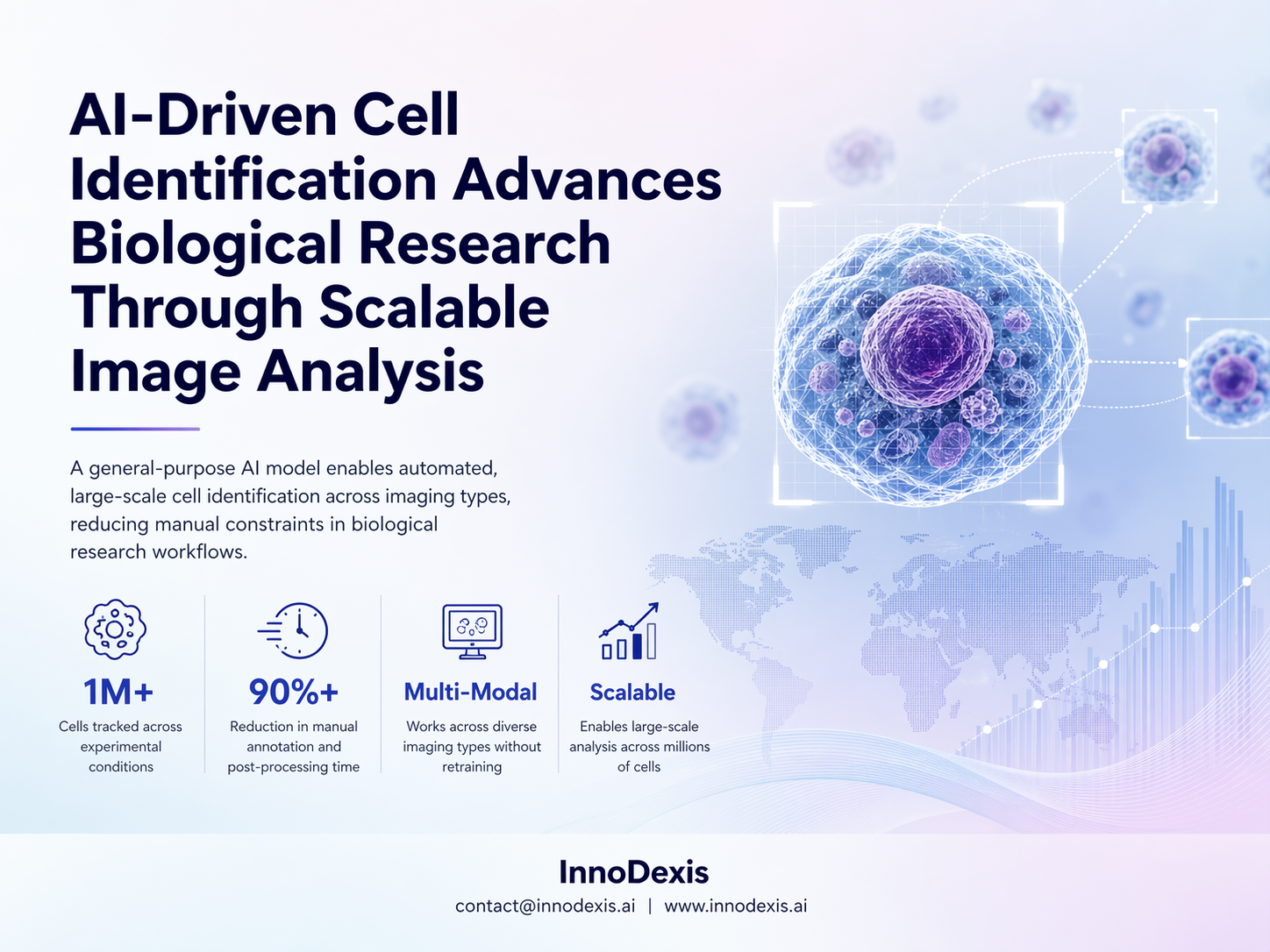
InnoDexis has published its latest Innovation Intelligence Report covering artificial intelligence in biological research, analyzing advancements in AI-driven cell identification systems. The report highlights the development of a general-purpose model capable of identifying and tracking cells across diverse biological images. The analysis reveals that traditional manual annotation processes are being replaced by scalable AI-driven systems, enabling researchers to process significantly larger datasets across experimental conditions and accelerating analytical throughput in fields such as cancer research, immunology, and drug response studies.
Key Findings
A persistent bottleneck in biological research has been the manual identification of cells from imaging data, typically conducted on an image-by-image basis. This approach has constrained the speed and scale of analysis, particularly in experiments involving large datasets or multiple conditions.
Researchers at California Institute of Technology have developed a general-purpose AI model known as CellSAM (Cell Segment Anything Model), designed to automate the identification of cells across biological images. The model introduces a system-level approach to cell segmentation, shifting from manual workflows to automated analysis.
CellSAM has been trained on large-scale, manually labeled biological image datasets, enabling it to generalize across different imaging modalities. The ability to operate without retraining across multiple imaging types reduces the need for domain-specific model adjustments and enhances applicability across research environments.
The system is capable of tracking millions of cells across varying experimental conditions, significantly increasing the scale at which biological data can be analyzed. This capability addresses limitations associated with manual annotation and error correction processes that traditionally require extensive time and labor.
By replacing hours of annotation and post-processing with automated workflows, the model reduces human intervention in repetitive analytical tasks. This shift allows researchers to allocate resources toward higher-level experimental design and interpretation rather than data preparation.
Strategic Insight and Trend Analysis
The development of general-purpose AI models such as CellSAM reflects a broader shift toward foundation-model architectures within biological research. Rather than designing task-specific tools for individual experiments, the emergence of adaptable models capable of operating across datasets and modalities indicates a transition toward scalable analytical systems.
The removal of manual bottlenecks in cell identification represents a structural change in how biological data is processed. Historically, the pace of discovery has been influenced not only by experimental design but also by the capacity to interpret imaging data efficiently. By automating cell segmentation at scale, AI systems enable continuous analysis across larger datasets, increasing both speed and consistency.
This transition also introduces a change in research dynamics. As throughput increases, the volume of observable patterns expands, allowing researchers to identify trends and anomalies that may not have been detectable within smaller datasets. The shift from manual to automated analysis therefore extends beyond efficiency gains and begins to influence the nature of scientific discovery itself.
The ability to apply a single model across multiple imaging types without retraining further indicates a move toward standardized analytical infrastructure in biology. Such systems reduce fragmentation in research workflows and support broader integration of datasets across laboratories and institutions.
Global and Industry Implications
For corporates and R&D teams, the availability of scalable cell identification systems enables faster experimental cycles and more efficient data utilization. This can support accelerated development timelines in areas such as drug discovery, diagnostics, and therapeutic research.
For investors and capital allocators, the emergence of general-purpose biological AI models indicates a shift toward platform-based opportunities. Systems that address core analytical bottlenecks may serve as foundational infrastructure for multiple applications within the life sciences sector.
For policymakers and national innovation bodies, advancements in AI-driven biological analysis highlight the importance of integrating computational capabilities into research ecosystems. Supporting infrastructure for large-scale data processing and model deployment may become a key component of national research strategies.
InnoDexis Statement
“The transition from manual cell identification to scalable AI-driven analysis reflects a broader shift toward computational infrastructure in biology, where analytical capacity increasingly defines the pace and scope of scientific discovery,” noted InnoDexis in its latest intelligence report.
Conclusion
The development of AI models capable of automating cell identification marks a significant step in addressing long-standing limitations in biological research workflows. By enabling large-scale analysis across imaging types and experimental conditions, such systems expand both the speed and depth of scientific investigation. As foundation-model approaches continue to evolve, their role in shaping research methodologies and discovery patterns is likely to increase. The complete CellSAM Innovation Intelligence Report is available to InnoDexis subscribers and enterprise clients.
About InnoDexis
InnoDexis is a global Innovation Intelligence platform that tracks, analyzes, and interprets breakthrough innovations, prototypes, and emerging technologies across industries and countries. Its intelligence helps corporates, investors, and policymakers understand the true structure and direction of global innovation. Learn more at innodexis.ai.