AI Clinical Documentation Systems Increase Physician Workload with 602 Monthly Interruptions, Revealing Structural Implementation Gaps
An ethnographic study of clinical speech recognition systems shows rising error-driven workload and hidden AI training labor, challenging core assumptions of healthcare
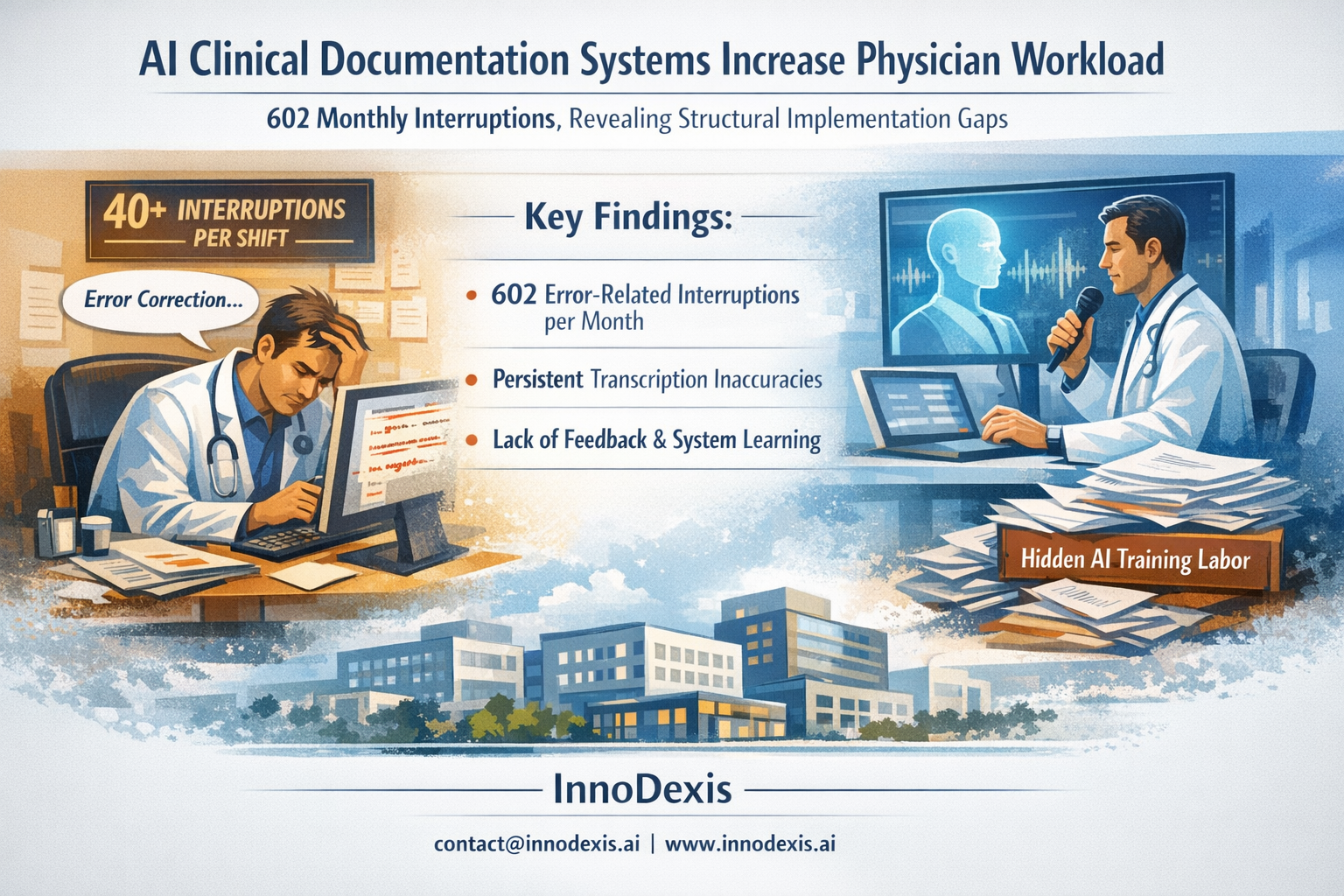
InnoDexis has published its latest Innovation Intelligence Report covering artificial intelligence in clinical documentation, analyzing real-world deployment of automated speech recognition systems in hospital environments during March 2026. The report reveals that AI-driven documentation systems, rather than reducing administrative burden, are introducing significant workflow disruptions and hidden labor demands. Based on a multi-method ethnographic study conducted in Danish hospitals, the findings highlight a structural gap between AI system design and clinical workflow realities, with measurable increases in physician workload and limited evidence of operational efficiency gains.
Key Findings
The analysis identifies a substantial increase in physician workload linked to AI-driven documentation systems. Doctors experience approximately 602 error-related interruptions per month, with more than 40 interruptions per shift. This frequency translates to a continuous correction burden that disrupts clinical workflows and reduces time available for patient care activities.
The system demonstrates persistent transcription inaccuracies across key areas including words, sentence structures, and medical terminology. These errors require manual correction by clinical staff, effectively transferring administrative tasks traditionally handled by medical secretaries directly onto physicians without reducing their existing clinical responsibilities.
A critical operational gap is the absence of a feedback loop within the system. Physicians correcting transcription errors have no visibility into whether their inputs improve system performance over time. This creates a “working without feedback” environment where effort invested in corrections does not translate into observable efficiency gains.
The analysis also reveals a hidden labor mechanism described as “pseudo-data work,” where clinicians unintentionally train AI systems through continuous corrections. This process occurs without explicit acknowledgment, compensation, or consent, effectively embedding AI training responsibilities within routine clinical workflows.
A significant governance failure was identified in which correction data was not transmitted to the system provider for a full year. This undetected breakdown in the data pipeline prevented system learning and highlights deficiencies in monitoring, accountability, and system oversight.
Strategic Insight and Trend Analysis
The findings point to a broader structural issue in AI deployment within complex professional environments. Clinical documentation systems are designed with the expectation that automation will reduce workload and improve efficiency. However, the observed outcomes suggest that without alignment to real-world workflows, AI systems can redistribute labor rather than eliminate it.
The emergence of pseudo-data work represents a critical shift in how AI systems are maintained and improved. Instead of centralized training processes, continuous model improvement is being offloaded onto end users, embedding training responsibilities into operational workflows. This introduces a new category of labor that is neither formally recognized nor systematically managed.
Another defining trend is the mismatch between system design and workflow integration. Rather than adapting to existing clinical practices, the technology requires clinicians to modify their workflows to accommodate system limitations. This inversion increases cognitive load and introduces inefficiencies that counteract the intended benefits of automation.
The absence of feedback mechanisms further compounds these issues. Without transparency into system improvement, users cannot assess whether their efforts contribute to long-term performance gains. This reduces trust in the system and limits opportunities for iterative improvement based on user interaction.
Collectively, these findings indicate that the next phase of AI development in healthcare will require a shift from technology-centric design to workflow-centric integration, where system performance is evaluated not only by accuracy metrics but by its impact on human work patterns and operational efficiency.
Global and Industry Implications
For corporates and R&D teams, the findings highlight the importance of designing AI systems that integrate seamlessly into existing workflows. Technologies that require users to adapt their processes may face adoption challenges and fail to deliver expected efficiency gains, particularly in high-stakes environments such as healthcare.
For investors and capital allocators, the analysis introduces a new dimension of risk in AI deployment: implementation risk. Systems that perform well in controlled environments may underperform in real-world settings, affecting scalability and long-term value creation. Evaluating user interaction and workflow impact will become critical in assessing investment opportunities.
For policymakers and healthcare regulators, the emergence of hidden training labor and governance gaps underscores the need for new regulatory frameworks. Standards addressing transparency, accountability, and labor implications of AI systems may become necessary to ensure safe and effective deployment in clinical environments.
InnoDexis Statement
“The emergence of hidden training labor and workflow disruption in clinical AI systems signals a need to redefine how performance, accountability, and value are measured in real-world AI deployments,” noted InnoDexis in its latest intelligence report.
Conclusion
The analysis of AI-driven clinical documentation systems reveals a critical gap between expected and observed outcomes in healthcare automation. While the technology aims to streamline documentation processes, current implementations demonstrate increased workload, workflow disruption, and limited transparency in system improvement.
As healthcare systems continue to adopt AI technologies, the focus will shift toward ensuring that these systems enhance, rather than hinder, clinical workflows. Monitoring real-world performance, integrating user feedback mechanisms, and addressing hidden labor dynamics will be essential in determining the long-term viability of AI in healthcare documentation.
The complete AI in Healthcare — Clinical Documentation & Speech Recognition Innovation Intelligence Report is available to InnoDexis subscribers and enterprise clients.
About Innodexis
InnoDexis is a global Innovation Intelligence platform that tracks, analyzes, and interprets breakthrough innovations, prototypes, and emerging technologies across industries and countries. Its intelligence helps corporates, investors, and policymakers understand the true structure and direction of global innovation. Learn more at innodexis.ai.