Agentic AI Systems Expand Across 8 Countries as Multi-Agent Architectures and Governance Efforts Accelerate
An analysis of 20 innovations shows AI transitioning from assistive tools to autonomous operators across enterprise, infrastructure, and governance layers.
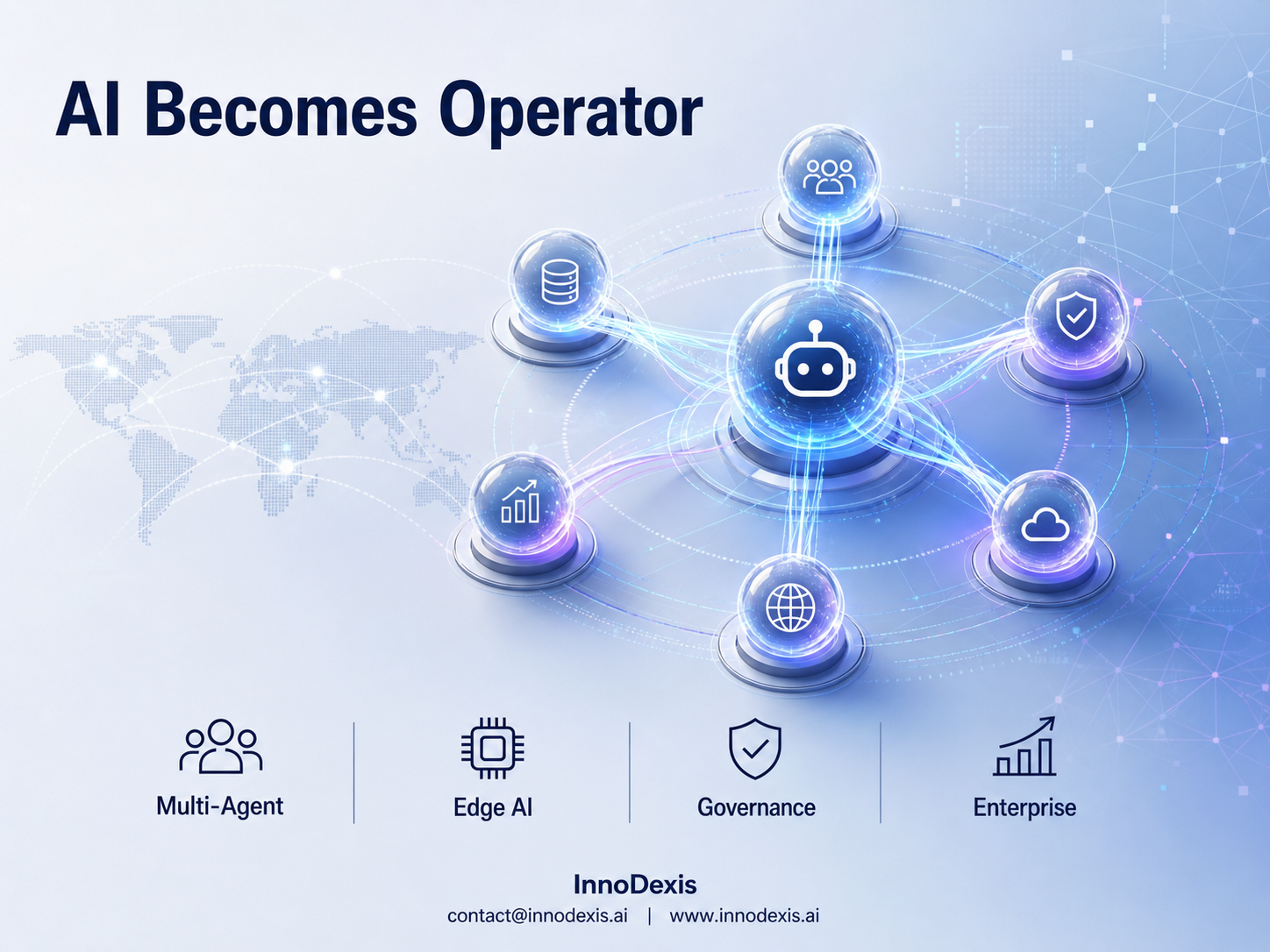
InnoDexis has published its latest Innovation Intelligence Report covering agentic artificial intelligence and multi-agent systems, analyzing 20 innovations across 8 countries and 18 institutions during April 2026. The report reveals that AI systems are increasingly designed to make, coordinate, and execute decisions rather than support them. With growing enterprise deployments, the emergence of multi-agent architectures, and approximately 25% of developments focused on governance, the data indicates a structural shift toward AI as an operational layer across industries.
Key Findings
A total of 20 innovations across 8 countries and 18 institutions were identified in April 2026, indicating early but globally distributed momentum in agentic AI system development. The concentration of activity across multiple geographies suggests coordinated progress toward operational AI capabilities.
Multi-agent architectures are emerging as a dominant system design. These architectures divide tasks across specialized agents, enabling coordinated execution and improving system-level reliability. The approach reflects a shift from monolithic AI models toward distributed reasoning and task orchestration frameworks.
Enterprise deployment is already visible in selected implementations. Platforms such as TeamViewer are operating AI systems at scale, demonstrating that agentic AI is moving beyond experimental environments into real-world operational settings.
On-device AI agents are gaining traction as part of the infrastructure layer. These systems prioritize privacy, reduce latency, and decrease dependence on centralized cloud environments, indicating a shift toward more decentralized AI deployment models.
Governance and safety considerations account for approximately 25% of tracked developments. This includes efforts focused on alignment, control mechanisms, and regulatory frameworks, highlighting the increasing importance of oversight as AI systems take on more autonomous roles.
Strategic Insight and Trend Analysis
The April 2026 findings indicate a transition from AI as a decision-support tool to AI as an operational actor within complex systems. This shift is characterized by the integration of execution, coordination, and reasoning capabilities into unified frameworks capable of managing workflows independently.
The emergence of multi-agent architectures suggests that scalability in AI systems may depend on distributing tasks among specialized agents rather than relying on single, generalized models. This design enables modularity, adaptability, and improved reliability, particularly in environments requiring continuous decision-making and execution.
Simultaneously, the rise of on-device agents reflects a parallel infrastructure evolution. By enabling local processing, these systems address constraints related to latency, data privacy, and network dependency. This indicates that the agentic AI stack is developing across both centralized and decentralized environments.
Governance developments further reinforce the structural nature of this transition. With approximately one-quarter of innovations addressing safety and alignment, the data suggests that control frameworks are being developed in parallel with capability expansion. This co-evolution of performance and oversight is indicative of a technology moving toward broader deployment readiness.
Collectively, these elements point to the emergence of agentic AI as a full-stack paradigm, encompassing execution layers, reasoning systems, infrastructure models, and governance mechanisms. The convergence across these layers suggests that the shift is systemic rather than incremental.
Global and Industry Implications
For corporates and R&D teams, the findings indicate that enterprise systems may increasingly be designed around AI agents capable of managing workflows autonomously. This may require rethinking software architectures, operational processes, and human-machine interaction models.
For investors and capital allocators, the emergence of agentic AI across multiple layers suggests opportunities in platforms that integrate execution, coordination, and infrastructure capabilities. Early-stage activity across 20 innovations indicates a developing but not yet saturated investment landscape.
For policymakers and national innovation bodies, the growing emphasis on governance highlights the need for regulatory frameworks that address autonomous decision-making systems. Ensuring alignment, accountability, and safety will be central as AI transitions into operational roles.
InnoDexis Statement
“The April 2026 data indicates that agentic AI is evolving as a full-stack system where execution, reasoning, infrastructure, and governance are developing simultaneously, marking a transition from assistive intelligence to operational autonomy,” noted InnoDexis in its latest intelligence report.
Conclusion
The April 2026 Agentic AI and Multi-Agent Systems analysis reflects a shift toward AI systems capable of independently managing tasks, coordinating processes, and executing decisions across domains. As enterprise deployments expand, multi-agent architectures mature, and governance frameworks evolve, the role of AI is moving toward operational integration. Monitoring how these systems scale across industries such as enterprise automation, healthcare, and research environments will be critical in understanding the next phase of AI adoption. The complete Agentic AI and Multi-Agent Systems Report is available to InnoDexis subscribers and enterprise clients.
About InnoDexis
InnoDexis is a global Innovation Intelligence platform that tracks, analyzes, and interprets breakthrough innovations, prototypes, and emerging technologies across industries and countries. Its intelligence helps corporates, investors, and policymakers understand the true structure and direction of global innovation. Learn more at innodexis.ai.