A Thousand-Cycle Self-Healing Composite and a Material That Repairs at 196 Degrees Celsius Lead 31 Research Signals as Defence Agencies Fund the Field's Most Advanced Results
A dual-stream analysis of 31 research and 2 corporate signals finds that self-repair has crossed from laboratory phenomenon to specifiable engineering property in 2026, that the commercial layer remains nearly silent, and that circularity compliance is the more credible near-term commercial entry point than durability performance.
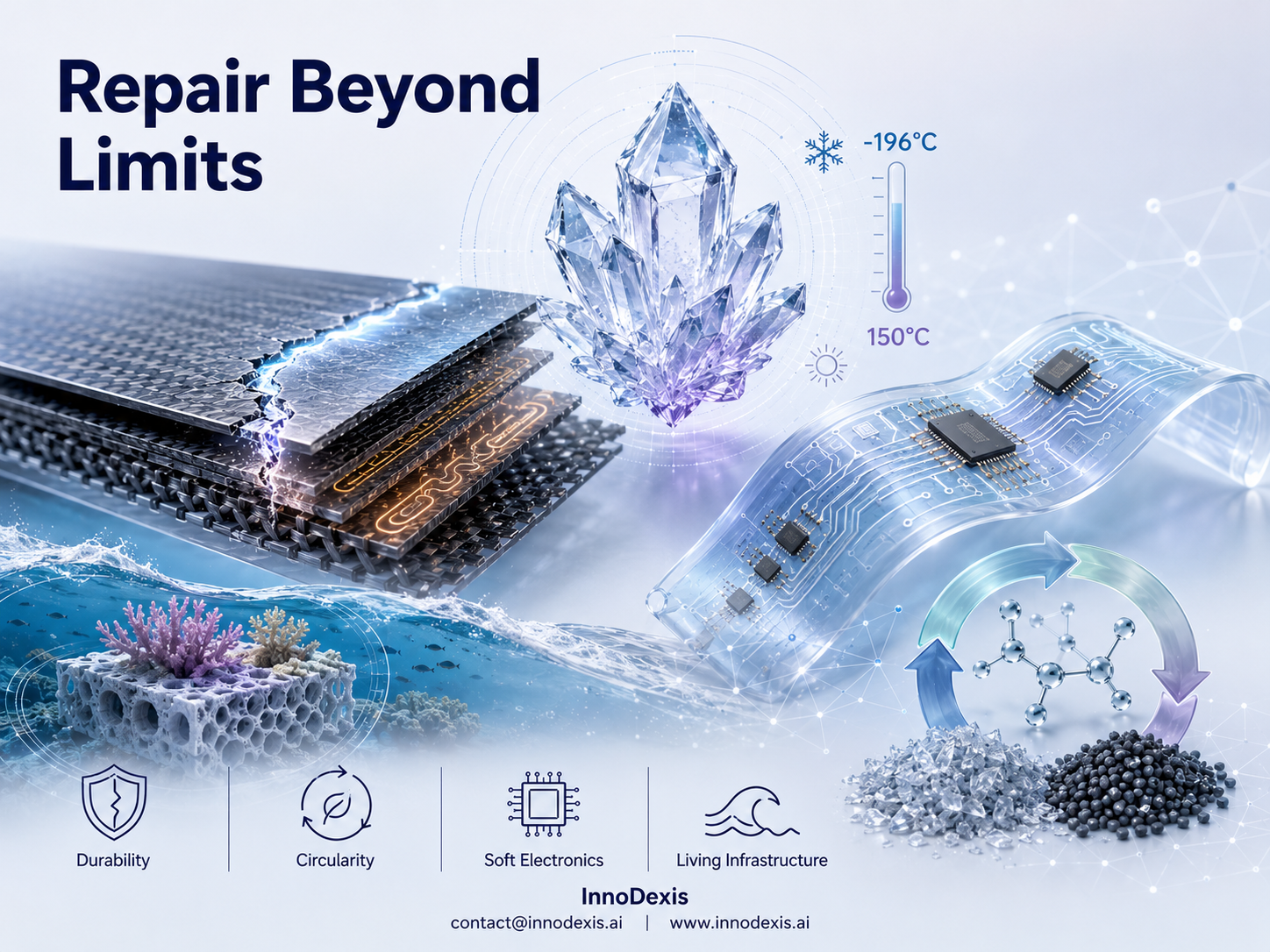
InnoDexis has published its latest Innovation Intelligence Report covering regenerative and self-repairing materials, analyzing 31 research signals and 2 corporate signals captured between 6 January and 11 August 2026. The report reveals that three results define a field threshold: a fibre-reinforced composite completing more than 1,000 consecutive fracture-and-heal cycles under automated testing, an organic crystal repairing itself at −196 degrees Celsius across a 350-Kelvin operating range, and a full transistor stack built from self-healing polymers surviving one week of in-vivo implantation. Against these laboratory advances, the corporate stream produced two signals — a ratio of approximately 15 research records to every one commercial announcement.
Key Findings
The thousand-cycle composite result from North Carolina State University, published in the Proceedings of the National Academy of Sciences, is the anchor of the corpus and the most consequential quantitative result in the dataset. A thermoplastic healing agent is three-dimensionally printed as a continuous interlayer onto fibre reinforcement, with embedded carbon-based heater layers applying current to melt and re-bond delamination sites. The design starts two to four times more delamination-resistant than an unmodified composite, meaning the healing capability is not purchased with a static-property penalty. The technology is patented, licensed to Structeryx Inc., and the company is stated to be seeking industry and government partners across aerospace, automotive and energy.
The New York University organic crystal result removes the temperature constraint that had categorically excluded self-repair from cryogenic, polar, deep-sea and space applications. The material uses permanent dipole interactions rather than chain mobility, repairing mechanical damage and recovering optical transmission at −196 degrees Celsius while remaining functional to 150 degrees Celsius. A working range of nearly 350 Kelvin in a self-healing material is without precedent in the corpus and opens an application set that had no incumbent competitor — space structures, polar instrumentation, deep-sea optics, and cryogenic flexible electronics.
Soft electronics is the application domain where self-repair mechanisms are being industrialised fastest. Sungkyunkwan University built every functional layer of a transistor — electrodes, semiconductors and dielectric — from self-healing polymers, recovering performance described as nearly indistinguishable from the pristine state after severe physical damage, with one week of in-vivo implantation validated. Seoul National University, working with MIT, replaced the electrode in a dielectric elastomer actuator with a phase-transitional ferrofluid that heals severed circuits, reconfigures around damaged areas, and achieves 91 per cent recovery across multiple reuse cycles. Tufts University fabricated complete integrated circuits on self-repairing eutectogel threads requiring no clean room or photolithography. A fourth collaboration between Jilin University and Xi'an Jiaotong-Liverpool University produced a self-healing MXene hydrogel sensor retaining more than 94 per cent of its water after six hours at 38 degrees Celsius and stretching to 800 per cent strain.
Self-repair and recyclability are converging on the same chemistry, and that convergence is the most strategically significant pattern in the corpus. A reversible bond that enables healing is the same bond that enables a material to be unmade. EMPA recovered more than 90 per cent of both epoxy and phosphorus through chemical recycling with no significant loss after ten thermomechanical rounds, and has stated that its manufacturing process has been improved to industrial scalability with active partner-seeking underway. Fraunhofer ICT took a carbon-fibre vitrimer through passenger-rail fire safety norms for heat release, smoke development and toxicity — the only record in the corpus where a self-repairing chemistry has cleared a formal safety standard. A Department of Energy team converted mixed post-consumer PET waste into a dynamic covalent adhesive that outperformed several commercial epoxies and bonded underwater.
Two United States defence programmes have deployed self-repairing living infrastructure in open water — the only operational deployments in the corpus. The University of Miami ECoREEF project, funded through DARPA Reefense, deployed three-dimensionally printed porous structures with actively restored corals, dissipating up to 98 per cent of incoming wave energy under tested conditions with corals accounting for as much as 56 per cent of total reduction. Rutgers University, also through DARPA Reefense, installed oyster-colonised porous concrete modules at Tyndall Air Force Base achieving more than 90 per cent wave power reduction, with the system designed to strengthen over time as organisms colonise it.
Five of 31 corpus records carry United States defence funding — including the two most advanced results, the thousand-cycle composite and the deployed coastal reefs. DARPA Reefense, the Department of Defense Strategic Environmental Research and Development Program, the US Navy, and the US Air Force Multi-University Research Initiative collectively represent the primary capital source pulling the field forward. Nineteen of 31 records disclose public funding and corporate funding is absent from all but the enabling-layer records, where it arrives through state-brokered structures rather than direct sponsorship.
Strategic Insight and Trend Analysis
The most consequential strategic finding of the regenerative and self-repairing materials report is not the laboratory performance achieved in 2026 but the identification of the commercial route through which these results are most likely to reach products. Self-healing has historically struggled to justify its cost premium because the benefit — extended service life — is realised years after purchase by whoever holds the maintenance obligation, frequently not the purchaser. Circularity does not share this problem. End-of-life obligations are becoming regulatory, near-term, and enforceable, falling on manufacturers. A dynamic covalent network sold as a recyclability solution has a compliance-driven buyer today; the same material sold as self-healing has a maintenance-driven buyer several years out.
The Pusan National University self-renewing air filter coating confirms this route with the only quantified corporate record in the corpus. Dynamic imine chemistry entered a commercial product not through aerospace or rail but through air filtration — a high-volume, low-margin, replacement-driven market with no qualification barrier comparable to structural applications. The chemistry that wins commercial entry in the near term will do so through unglamorous, high-volume, retrofit-compatible applications rather than through the headline structural results the research literature emphasises.
The defence funding structure adds a second route: qualification and dual-use licensing through procurement rather than commercial demand. A technology funded primarily by defence agencies reaches commercial markets through qualification programmes, not product launches, which is precisely the explanation for the 15-to-1 ratio of research to corporate signals. Structeryx is the vehicle to watch — the only entity commercialising a self-repairing structural material with a published thousand-cycle result, a documented manufacturing-compatibility constraint, and an explicitly stated search for industry and government partners.
Global and Industry Implications
For corporates and R&D teams, the EMPA recyclable epoxy and the Fraunhofer ICT rail-certified vitrimer are the highest-priority partnership targets in the corpus despite holding less impressive headline numbers than the North Carolina State composite. Both have stated partner-seeking availability, both have addressed the qualification and certification barriers that stop novel chemistries entering regulated applications, and both offer the circularity compliance rationale that creates a near-term buyer rather than a deferred maintenance argument. The SILKBIOMED spinout from the Universidad Politécnica de Madrid — with a standardised manufacturing process for a silk fibroin regenerative brain patch already in place — represents the most advanced biomaterials translation pathway in the corpus for organisations with interests in neurological device development.
For investors and capital allocators, Structeryx Inc. is the specific vehicle warranting near-term monitoring as the only entity commercialising a thousand-cycle structural result with a documented qualification path. The report identifies the first Structeryx development agreement with an aerospace, wind-energy, or automotive partner as the observable signal that confirms the laboratory result survives industrial scrutiny. The cryogenic self-healing crystal from New York University represents the earliest-stage but most differentiated opportunity in the corpus — with no incumbent competitor in the cryogenic application niche and a first specification citation in a space or polar programme representing the category-creation event. Four patent filings outside the named spinout cohort — covering the Department of Energy PET adhesive, the Kaunas geopolymer, the UC Irvine sweat sensor, and the Washington University fuel-cell catalyst support — represent additional licensing candidates in adjacent application areas.
For policymakers and national innovation bodies, the corpus confirms a division of research labour between the United States and Europe that has direct implications for public funding strategy. United States defence agencies are funding the highest-performance structural results and the only operational deployments, pulling the technology forward through qualification. Germany and Switzerland are funding certification work, recyclability validation, and manufacturing process development — the unglamorous problems that determine whether a chemistry can be sold. For national innovation bodies outside these two systems, the Lithuanian waste-derived geopolymer result — a single-institution bet producing a material that strengthens rather than degrades under repeated high-temperature exposure from 100 per cent waste precursors — identifies a model for targeted materials innovation bets in niche applications with clear decarbonisation co-benefits and without established incumbent competitors.
InnoDexis Statement
"Self-repair has crossed from a laboratory phenomenon to a specifiable engineering property in 2026 — but the commercial route into this field runs through circularity compliance rather than durability marketing, because that is the order in which a buyer will evaluate it," noted InnoDexis in its latest intelligence report.
Conclusion
The regenerative and self-repairing materials report establishes that three results in 2026 define a field threshold — a thousand-cycle composite, a cryogenic self-healing crystal, and a fully self-healing transistor stack surviving implantation — while the corporate layer remains at a 15-to-1 ratio to research signals, consistent with a qualification lag rather than a market failure. Across 31 research and 2 corporate signals, the evidence confirms defence agencies as the primary capital source, EMPA and Fraunhofer ICT as the highest-priority partnership targets for the circularity commercial route, and Structeryx as the specific vehicle to monitor for the first structural composite qualification agreement. As Structeryx announces its first development partner, EMPA and Fraunhofer name industrial licensees, a second and third self-renewing consumable product appears in adjacent low-qualification categories, and the NYU cryogenic crystal receives its first specification citation, monitoring the conversion of 2026's laboratory thresholds into qualified commercial entries will determine whether this field follows the defence-to-commercial licensing route or the circularity-compliance route — and how quickly it does either. The complete Regenerative and Self-Repairing Materials August 2026 Report is available to InnoDexis subscribers and enterprise clients.
About InnoDexis
InnoDexis is a global Innovation Intelligence platform that tracks, analyzes, and interprets breakthrough innovations, prototypes, and emerging technologies across industries and countries. Its intelligence helps corporates, investors, and policymakers understand the true structure and direction of global innovation. Learn more at innodexis.ai.