3D Predictive Modeling of Mosquito Flight Behavior Enables Data-Driven Disease Prevention Strategies
A dataset of over 53 million observations reveals structured mosquito flight patterns, offering new approaches to vector control and public health intervention.
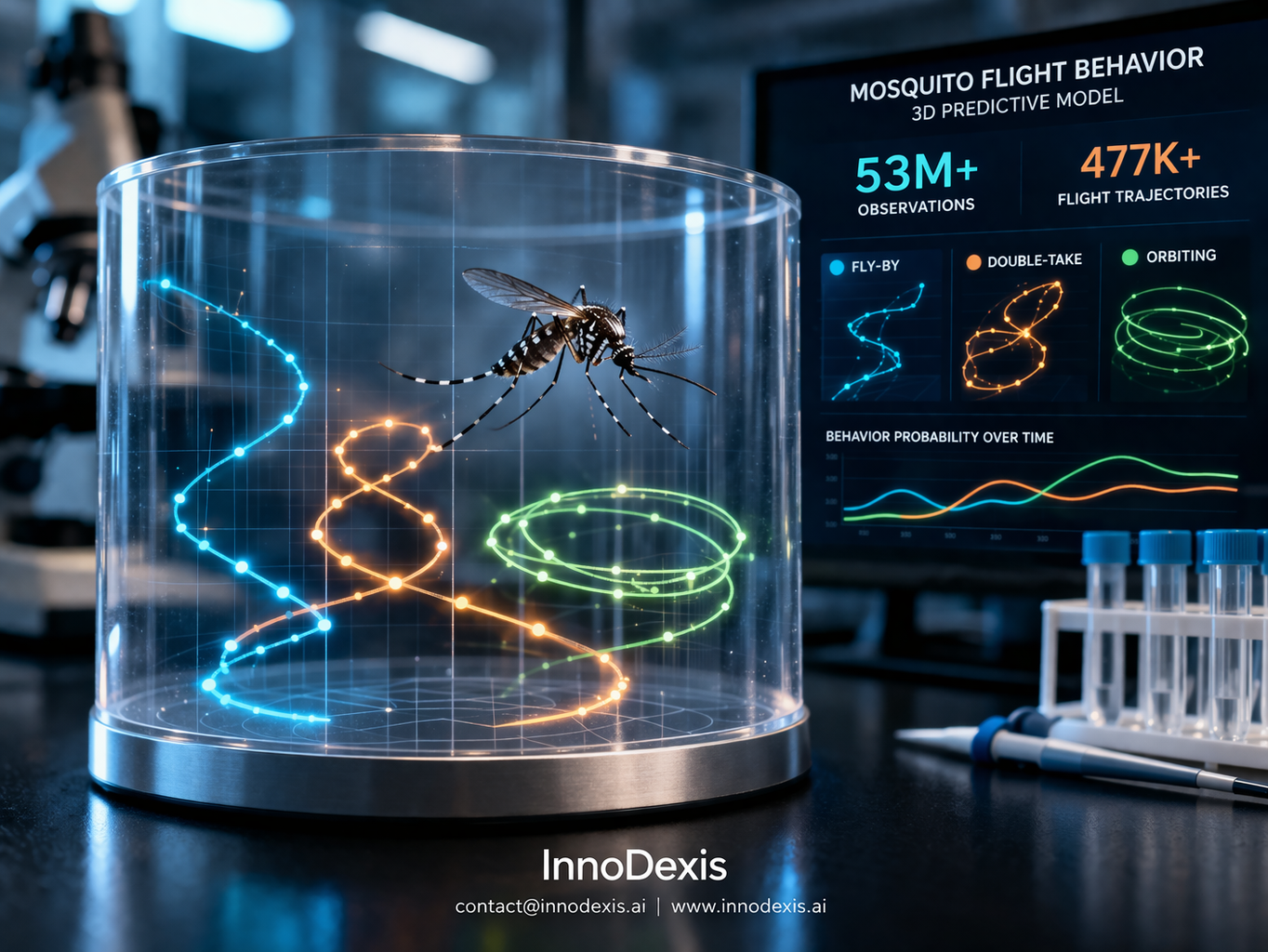
InnoDexis has published its latest Innovation Intelligence Report covering predictive modeling in vector biology, analyzing large-scale experimental datasets on mosquito flight behavior. The report reveals that researchers from MIT, Georgia Tech, and UC Riverside have developed a three-dimensional predictive model based on more than 53 million data points and over 477,000 tracked flight paths of Aedes aegypti mosquitoes. The findings demonstrate that mosquito movement can be systematically categorized and predicted, providing a foundation for data-driven disease prevention strategies targeting one of the leading causes of vector-borne mortality globally.
Key Findings
Mosquitoes are responsible for more than 770,000 deaths annually, making them one of the most significant contributors to global mortality from infectious diseases. Understanding and predicting their behavior remains a central challenge in public health and disease prevention.
The research introduces a three-dimensional predictive model of mosquito flight behavior, developed using controlled laboratory experiments. The dataset includes over 53 million individual data points and more than 477,000 recorded flight trajectories, representing one of the most extensive quantitative analyses of mosquito movement to date.
The study focuses on Aedes aegypti, a primary vector for diseases such as dengue, Zika, and yellow fever. By tracking flight paths under controlled conditions, researchers were able to convert complex behavioral patterns into measurable and analyzable data.
Three distinct flight behaviors were identified within the model: fly-by movements, double-take responses, and orbiting patterns. The orbiting behavior was observed to be triggered by combined sensory inputs, including carbon dioxide and visual cues, indicating that mosquito navigation is influenced by multisensory integration.
The ability to classify and predict these behaviors represents a shift from qualitative observation to quantitative modeling. This transformation enables a more structured understanding of how mosquitoes interact with their environment and potential hosts.
Strategic Insight and Trend Analysis
The development of a predictive model for mosquito flight behavior reflects a broader trend toward quantifying biological systems using large-scale data and computational modeling. Traditionally, mosquito behavior has been difficult to characterize due to its variability and dependence on environmental conditions. The introduction of high-resolution datasets and controlled experimental frameworks enables a more precise analysis of these dynamics.
By identifying discrete behavioral states such as fly-by, double-takes, and orbiting, the model provides a structured framework for interpreting how mosquitoes respond to sensory stimuli. The identification of orbiting behavior as a response to combined cues such as carbon dioxide and visual signals suggests that mosquito navigation is not random but follows identifiable patterns that can be modeled and predicted.
This approach also demonstrates the convergence of multiple disciplines, including mathematics, biology, and computational modeling. The use of large datasets to derive predictive insights aligns with methodologies commonly associated with artificial intelligence, although the model is grounded in experimentally validated biological data.
From a systems perspective, the ability to predict vector behavior introduces the possibility of designing targeted interventions based on how mosquitoes move and respond to environmental signals. Rather than relying solely on chemical or broad-spectrum control methods, future strategies may incorporate behavioral insights to improve effectiveness.
Global and Industry Implications
For corporates and R&D teams working in healthcare, biotechnology, and pest control, predictive modeling of mosquito behavior may enable the development of more targeted and efficient vector control technologies. Multisensory trap systems designed around observed behavioral patterns could improve capture rates and reduce disease transmission.
For investors and capital allocators, the integration of data-driven modeling into public health solutions represents an emerging area within health technology and biotechnology. Technologies that translate biological behavior into predictive systems may create new opportunities in disease prevention and environmental health.
For policymakers and national health agencies, improved understanding of mosquito behavior can support more effective disease control strategies. Data-driven approaches may enhance surveillance systems and intervention planning, particularly in regions where vector-borne diseases remain a major public health challenge.
InnoDexis Statement
“The ability to model mosquito behavior at scale transforms vector control from reactive intervention to predictive strategy, enabling more precise and data-driven approaches to disease prevention,” noted InnoDexis in its latest intelligence report.
Conclusion
The development of a three-dimensional predictive model for mosquito flight behavior demonstrates how large-scale data analysis can transform the understanding of complex biological systems. By identifying structured movement patterns and linking them to sensory inputs, the research provides a foundation for more targeted and effective disease prevention strategies. As predictive modeling continues to evolve, its application to vector biology may play an increasingly important role in addressing global health challenges. The complete Vector Behavior Intelligence Report is available to InnoDexis subscribers and enterprise clients.
About InnoDexis
InnoDexis is a global Innovation Intelligence platform that tracks, analyzes, and interprets breakthrough innovations, prototypes, and emerging technologies across industries and countries. Its intelligence helps corporates, investors, and policymakers understand the true structure and direction of global innovation. Learn more at innodexis.ai.