128 Disruption Claims Exist for Every Confirmed Evidence Trail Across 4,729 June 2026 Research Records as Patent, Transfer, and Spin-Off Signals Surface 11 Commercialisation-Track Technologies
A three-bar evidence screen applied to the full June 2026 Research stream finds that 29.8% of records use disruption-flavoured language while only 0.23% carry a confirmed patent, academic-to-industry transition, and named licensing partner or spin-off simultaneously.
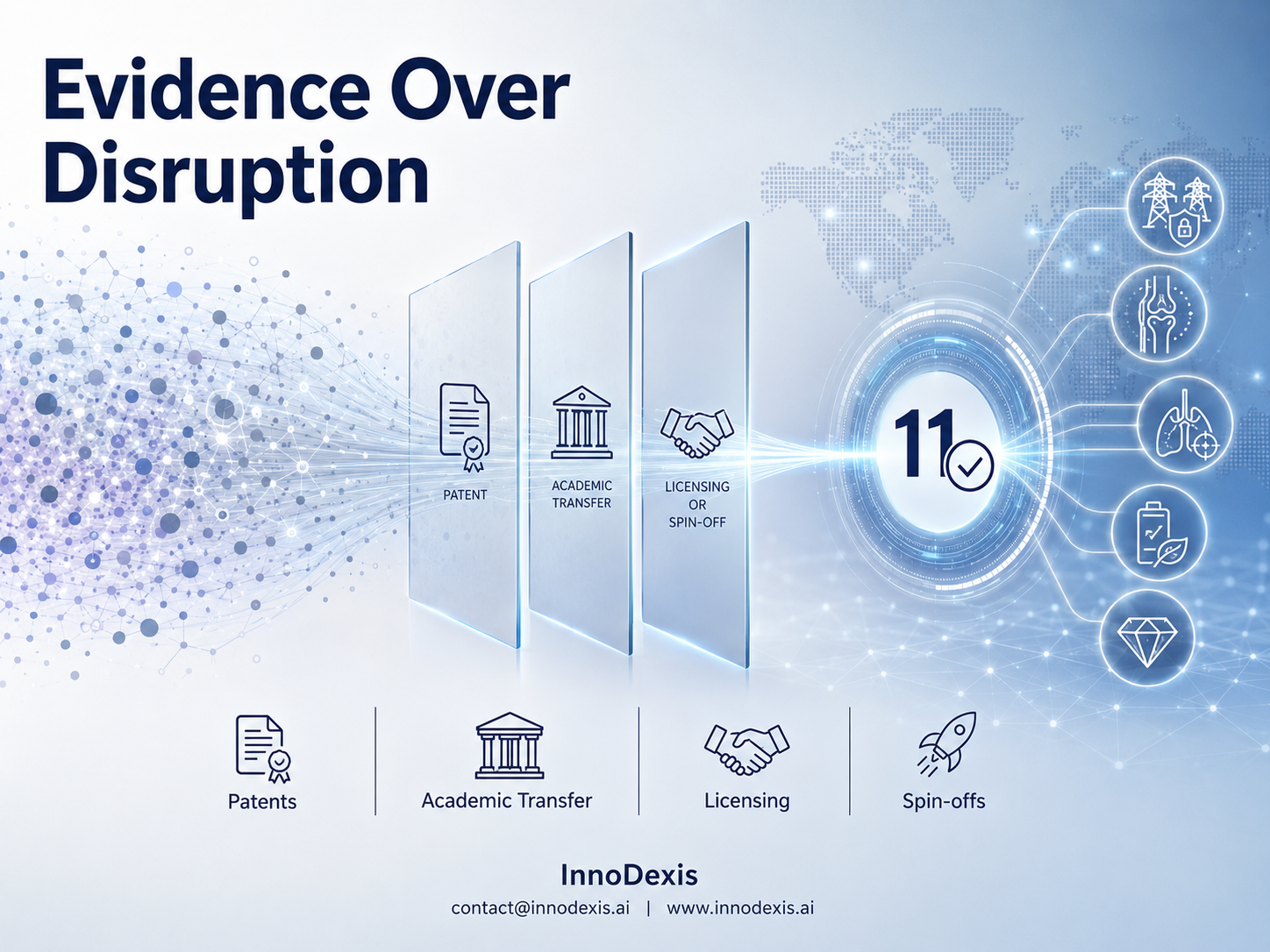
InnoDexis has published its latest Research Stream Intelligence Report — Patent and Transfer Signal Radar — screening all 4,729 valid Research-stream records from June 2026 against a three-bar evidence trail requiring an active patent application or grant, an explicit academic-to-industry transition statement, and either a named licensing deal or a spin-off company with a real name attached. The report reveals that 1,407 records — 29.8% of the Research stream — use disruption-flavoured language, while only 11 records clear all three evidence bars simultaneously, producing a 128-to-1 ratio between disruption claims and confirmed commercialisation evidence. Countries represented in the confirmed cohort are the United States, Germany, Spain, and China.
Key Findings
The three-bar evidence funnel narrows the Research stream by more than 400-fold from disruption claim to confirmed trail. Of 4,729 valid Research records, 1,407 carry self-described disruption language including terms such as breakthrough, could transform, or game-changing. Academic-transition language is the most common individual evidence signal but remains independently scarce. Patent signals and licensing deals — the components that matter most for a corporate partner or investor — are each rarer still. Only 11 records carry all three simultaneously, representing 0.23% of the screened population.
Oak Ridge National Laboratory developed Cyber Grid Guard, a patented blockchain-based framework protecting electric grid communications and validating data integrity in real time. The technology has been licensed to GridForge Energy Solutions, a startup incubated through LabStart — a non-profit purpose-built to commercialise technologies out of US national laboratories. ORNL frames the technology's purpose as unlocking over 100 gigawatts of underutilised grid capacity by giving utilities sufficient confidence in data integrity to run networks closer to their real operational limits.
Stanford University researchers identified that blocking a single ageing-related protein — 15-PGDH — can restore lost cartilage and prevent arthritis after knee injury in mice, with early signs of the same regenerative effect in ex vivo human cartilage samples. The underlying intellectual property has been licensed to Epirium Bio for further development toward a human therapy. Current treatment for osteoarthritis is overwhelmingly limited to pain management and eventual joint replacement surgery, with no approved therapy that regenerates lost cartilage. The ex vivo human tissue data represents a real step beyond mouse models, though it remains distant from a human clinical trial.
UT Southwestern Medical Center researchers developed mAb7, an experimental antibody targeting the PCDH7 protein to shrink non-small-cell lung cancer tumours in preclinical models — remaining effective against tumours already resistant to existing KRAS inhibitor drugs. The University of Texas System has filed a provisional patent, and a dedicated spin-off, ProtomAb Therapeutics Inc., has been formed specifically to continue the work. Drug resistance is identified as the central long-term problem in targeted cancer therapy, and an antibody engineered to work specifically in resistant tumours addresses a more durable and differentiated clinical need than most first-line oncology alternatives.
University of Pittsburgh researchers discovered a low-temperature process — below 1,000 degrees Celsius — using molten-metal catalysis to convert ethane directly into battery-grade graphite and hydrogen, compared with the approximately 3,000-degree process that dominates current graphite production. China's dominance of graphite processing is identified as a specific policy concern for US and European battery and electric vehicle manufacturers. A provisional patent has been filed and the research team has founded Graphonos Materials to commercialise the process, with early support from the University of Pittsburgh's Big Idea Center.
A Harbin Institute of Technology team led by Professor Zhu Jiaqi developed Zhenxin, a technology for producing one-carat lab-grown diamonds noted for exceptional hardness and chemical stability. The underlying intellectual property has received the China Patent Gold Award, the Heilongjiang Provincial Patent Gold Award, a National Technology Invention Award, and a gold medal at the Geneva International Invention Exhibition. The technology has transitioned into an incubated commercial enterprise, Tan Zhen Xin Cai, already producing consumer products. Six additional technologies cleared the same full three-bar evidence trail this month across DKFZ, University of Southern California, Sant Pau Research Institute, Carnegie Mellon University, Stanford University, and Berlin University Alliance.
Strategic Insight and Trend Analysis
The most consequential structural finding of the June 2026 Patent and Transfer Signal Radar is the quantification of the gap between disruption language and disruption evidence at research-stream scale. The 128-to-1 ratio is not a qualitative judgement about the relative quality of different research announcements — it is a direct measurement of how rarely the self-reported signals that dominate research coverage co-occur with the independently verifiable evidence signals that actually predict commercialisation. Any intelligence process calibrated primarily to disruption language — which accounts for 29.8% of the Research stream — is operating on a variable with a 0.23% precision rate against the outcome it is designed to find.
The five spotlight technologies illustrate how the evidence trail changes the analytical picture compared with headline language alone. Cyber Grid Guard is not primarily a cybersecurity story — it is a grid capacity story, where the commercial case is unlocking over 100 gigawatts of underutilised infrastructure rather than building a new security product. Graphonos Materials is not primarily a materials science story — it is a critical-minerals geopolitical story, where the timing of a domestic low-energy graphite process coincides precisely with the moment that China's dominance of graphite processing has become an explicit policy concern for US and European manufacturers. The evidence trail surfaces the commercial context that disruption language alone does not.
The geographic finding adds a further structural dimension. Confirmed patent and transfer activity concentrates in the United States and Germany — consistent with their overall Research-stream volume — but Spain and China both contribute confirmed spotlight technologies. The Sant Pau Research Institute spin-off Ivestatin Therapeutics and the HIT Zhenxin enterprise Tan Zhen Xin Cai each carry a complete three-bar evidence trail that would not have been surfaced by a geographic filter calibrated to the two largest research economies alone.
Global and Industry Implications
For corporates and R&D teams, the ORNL and GridForge Energy Solutions licensing structure and the UT Southwestern and ProtomAb Therapeutics spin-off each represent actionable partnership windows identified in the report as the earliest in the June 2026 confirmed cohort — both carry a named commercial vehicle already in place before broader market attention arrives. The DKFZ LIVEMAP project has explicitly lined up pharma and biotech evaluation partners, providing a directly named contact point for licensing-in conversations ahead of any headline-generating funding round.
For investors and capital allocators, the 128-to-1 disruption-to-evidence ratio provides an empirical basis for reweighting Research-stream sourcing processes away from disruption language and toward the patent, transfer, and licensing or spin-off combination that the report identifies as the actual predictive filter. ProtomAb Therapeutics raising a seed or Series A round within the next 12 months is the clearest near-term signal of whether outside investors reach the same KRAS-resistance differentiation conclusion the InnoDexis signal screen identified. Graphonos Materials completing its bench-scale continuous graphite system is the technical checkpoint determining whether the low-temperature process can plausibly reach commercial volumes — the milestone at which strategic investment or acquisition interest from battery manufacturers and automakers becomes most likely.
For policymakers and national innovation bodies, the Graphonos Materials graphite story sits at the intersection of a laboratory discovery and a multi-year geopolitical supply-chain concern that exists independent of any single company's success or failure. A domestic, lower-energy graphite production process arriving at the moment China's graphite processing dominance is an explicit policy concern for US and European battery supply chains represents a structural alignment between research output and policy priority that national innovation bodies and procurement agencies should track independent of individual funding milestones. The LabStart incubation model — a non-profit purpose-built to commercialise technologies out of US national laboratories — is identified as a replicable institutional model for converting patent assets into named commercial vehicles rather than licensing into passive portfolios.
InnoDexis Statement
"The 128-to-1 ratio between disruption claims and confirmed evidence trails in the June 2026 Research stream means that most breakthrough deal flow in research press coverage is noise — and the 11 technologies that clear the full evidence bar this month are the ones worth watching months before the rest of the market notices them," noted InnoDexis in its latest intelligence report.
Conclusion
The June 2026 Patent and Transfer Signal Radar establishes that confirmed commercialisation evidence is both rare and structurally distinct from the disruption language that dominates Research-stream coverage — with 11 confirmed technologies emerging from a 4,729-record screen at a 0.23% confirmation rate against a 29.8% disruption-language prevalence. Across five spotlight technologies spanning grid cybersecurity, cartilage regeneration, lung cancer drug resistance, battery-grade graphite, and lab-grown diamond materials, the evidence confirms that the patent, transfer, and licensing or spin-off combination surfaces commercially proximate research that headline disruption language systematically misses. As GridForge pursues its first named utility pilot, ProtomAb advances toward its first external fundraise, Graphonos builds toward bench-scale continuous production, and Epirium Bio progresses its cartilage therapy toward human trials, monitoring the conversion of each confirmed evidence trail into a commercial milestone will provide the most precise early intelligence on where June 2026's highest-conviction research signals become the market events of 2027 and 2028. The complete Patent and Transfer Signal Radar June 2026 Report is available to InnoDexis subscribers and enterprise clients.
About InnoDexis
InnoDexis is a global Innovation Intelligence platform that tracks, analyzes, and interprets breakthrough innovations, prototypes, and emerging technologies across industries and countries. Its intelligence helps corporates, investors, and policymakers understand the true structure and direction of global innovation. Learn more at innodexis.ai.